
The Assembly Line Model – A High-Level Introduction
This article provides a high-level overview of the Assembly Line Model – the practical core of Value Stream Thinking. It introduces the model’s structure, explains how it serves multiple complementary purposes, and shows how it scales from individual value streams to enterprise-wide landscapes. For context on why the choice of model matters, see Why the Way You Visualize Value Streams Matters. For a complete guide to all related articles, see the Value Stream Thinking Overview.
The model determines what we see.
What we see shapes our understanding.
Our understanding determines how we steer.
– Peter Vollmer –
The Assembly Line as a Model for Product Development
The assembly line serves as a simplified model of a typical product development process, structured around its main phases.

(1) From Idea to Backlog: This phase encompasses the process of defining what the product should achieve – whether through requirements, specifications, user stories, or other forms of description. It translates strategic intent into actionable items.
(2) Backlog: The backlog serves as a prioritized (ranked) list of work items, representing a structured set of instructions for what should be built next. In bigger systems, this could also be a cascade of backlogs at different levels.
(3) From Backlog to Delivery: This phase covers the actual development work – designing, implementing, testing, and preparing the product for release. It is the heart of the product creation process.
(4) From Delivery to Value Realization: Simply developing a product does not automatically generate value. Value is only realized when the product is deployed, adopted, and used effectively by end users – fulfilling its intended purpose (or in some cases, delivering unexpected outcomes).
The Assembly Line Model describes these phases in more detail for the development of a specific product, creating a common understanding of the underlying value stream.

The following section describes the key elements of the Assembly Line Model – what they represent and why they matter. Whenever there is a product, there is a value stream – so the model naturally starts from the product perspective. Reading from right to left, it traces the structure from the product and its hand-off back through integration, components, and backlogs to demand.
1 – The product (value delivery) and hand-off to the customer(s): The product is where value is actually delivered. Since we are in the context of product development, it could be a piece of software on a CD, a software package on a binary repository or version control system, a complete SaaS product running on server infrastructure, an ECU with its embedded software, or a whole car model ready for manufacturing. The examples are countless. The important thing is to define what is being produced and to whom the hand-off happens. Identifying the real product can already be a significant effort, but without a clear understanding of this part, the modeling will not work well.
A common pitfall is thinking about the product solely in terms of what the user can accomplish with it. While user outcomes are important, they don’t necessarily help us model how the product is developed. Instead, we need to focus on what is actually handed off at the end of the development process.
“The customer experience is the music you hear. The developed and assembled hardware and software are what make that experience possible – that is the product, in this case a music player.”

The same is true for product variants – often people get confused because there is not one product but many variants. This leads to the topic of domain value streams and how to model and standardize them.
In very large and complex environments, a single value stream can become so extensive that it must be partitioned into smaller, more manageable value streams. In such cases, the value stream under observation typically delivers a sub-product – a component or capability that contributes to a larger system. The final end product is then an aggregation of many such sub-products, each developed and delivered through its own dedicated value stream.1
2 – Final integration & testing: This is where the product comes together. Components are assembled, integrated, and validated against the acceptance criteria defined for the product. The key question is: What components are integrated to build the final product, and what must happen to make it ready for delivery?
In the diagram, the blue circles represent the activities that make this happen – such as integration, build, and testing – while the green circle at the end represents the quality gate: the point at which the integrated product is considered ready for hand-off. A detailed explanation of the visual language – what the circles, feedback cycles, and quality gates represent and how they are used in practice – is provided in What is in the Blue Boxes of the Assembly Line?
3 – Assembled components: Every product is built from components. These could be software modules, libraries, microservices, hardware subsystems, or supplier-delivered parts – depending on the product and its domain. The Assembly Line makes these components explicit: each one appears as its own box with its own activities, feedback cycles, and quality gate. For each component, we then recursively examine how it is constructed from its own sub-components – applying the same model pattern at the next level down.
4 – Stop decomposition: The recursive breakdown of components doesn’t continue forever. At some point, further decomposition no longer adds meaningful insight – either because the component is small enough to be owned and understood by a single team, or because its internals are not relevant to the questions the model needs to answer. Where to stop is a modeling decision, driven by purpose.
5 – Suppliers: Some components are not built internally but delivered by external suppliers. In most cases, their internal development process is either unknown or outside the scope of the model. They are treated as black boxes – what matters is what they deliver, when, and at what quality level. However, the interaction with suppliers is very much in scope: requirements and specifications flow from the value stream to the supplier, while components, releases, and quality information flow back. The integration of supplier-delivered components into the product appears in the Assembly Line like any other integration stage, with its own activities and quality gate. In practice, supplier dependencies are often a significant source of flow constraints – long delivery cycles, misaligned release schedules, or unclear quality agreements can all inhibit flow. Making these dependencies visible in the model is a prerequisite for managing them.
6 – Demand and backlogs: On the left side of the model sits demand – the work that enters the value stream. In most modern product development environments, demand is managed through backlogs: a prioritized list of features, enhancements, and fixes that drives what gets built next. As products grow in complexity, this typically results in a cascade of interconnected backlogs – from a product-level backlog down to team-level backlogs that align execution with the overall direction.2 In more traditional development processes, this part may look quite different, relying on formal requirements, specifications, or systems engineering artifacts.3 The Assembly Line accommodates both – what matters is that demand is made visible and its connection to the components being built is explicit.
With the basic structure in place, the Assembly Line can now serve as the foundation for multiple complementary purposes – each adding a new layer of insight to the same underlying model.
One Model – Multiple Purposes
The Assembly Line is not a single-use diagram. It is a structural model that serves different purposes depending on what needs to be understood or decided. Each purpose builds on the same underlying representation but highlights different aspects.
Structure – Making the Value Stream Visible
At its most basic level, as introduced at the beginning of the article, the Assembly Line makes the product development process visible: what is being built, from which components, through which integration and testing stages, and how it is handed off to the customer. Backlogs cascade from the product level to team-level work, connecting demand with execution. This structural view is the starting point for all further analysis.
Feedback Cycles – Revealing How the System Learns
The same structure reveals how feedback flows through the value stream. Every stage generates learning – from fast, localized loops within a team to longer cycles spanning multiple integration levels. The model makes these feedback cycles visible, showing where learning happens quickly, where it is delayed, and where defects escape into expensive downstream stages. In an iterative and incremental development environment, the shorter and more reliable these cycles are, the faster the system can learn, adapt, and deliver value. The article Feedback Cycle Times explores the relationship between stage structure, feedback speed, and defect detection in depth.

People and Organization – Enabling “Organize Around Value” Discussions
By overlaying people, locations, and organizational boundaries onto the Assembly Line, the model becomes a tool for organizational design. It shows who works where, how teams are distributed across the value stream, and where hand-offs and coordination overhead arise. This view supports deliberate decisions about team topologies, ownership boundaries, and structural alignment with the flow of value. The article Designing Organizations Around Value explores this topic in depth.

Measurement – Structurally Placed Observers
The Assembly Line also provides the scaffolding for a systematic measurement approach. Metrics are not standalone signals – they are structurally placed observers. The model distinguishes three levels: system-level KPIs that enable steering, cross-stage metrics that reveal flow constraints, and stage-level metrics that diagnose root causes. Flow metrics such as flow time, velocity, and deployment frequency make visible how fast and reliably value moves through the stream. Quality metrics – from defect escape rate to defect resolution time – show whether teams are building quality in or relying on downstream correction. Together, these measures give a balanced picture of speed, quality, and productivity – and they allow organizations to see whether reducing transaction costs, working in smaller batches, or applying shift-left practices truly accelerate learning and value delivery. The article Optimizing Value Streams Along the Assembly Line explores this topic in depth.

From Value Streams to Landscapes
One of the model’s key strengths is its recursive, self-similar structure. A value stream modeled with the Assembly Line can be zoomed into – revealing the detailed stages and feedback cycles within a sub-stream – or zoomed out, abstracting it into a component within a larger landscape.

This scalability means that detailed value stream maps and high-level landscape views are not separate artifacts – they are different zoom levels of the same model. Organizations can build landscapes top-down to capture the big picture, and complement them bottom-up with detailed value stream identifications. Over time, the two approaches meet in the middle and create a coherent, navigable view of the entire value creation system.
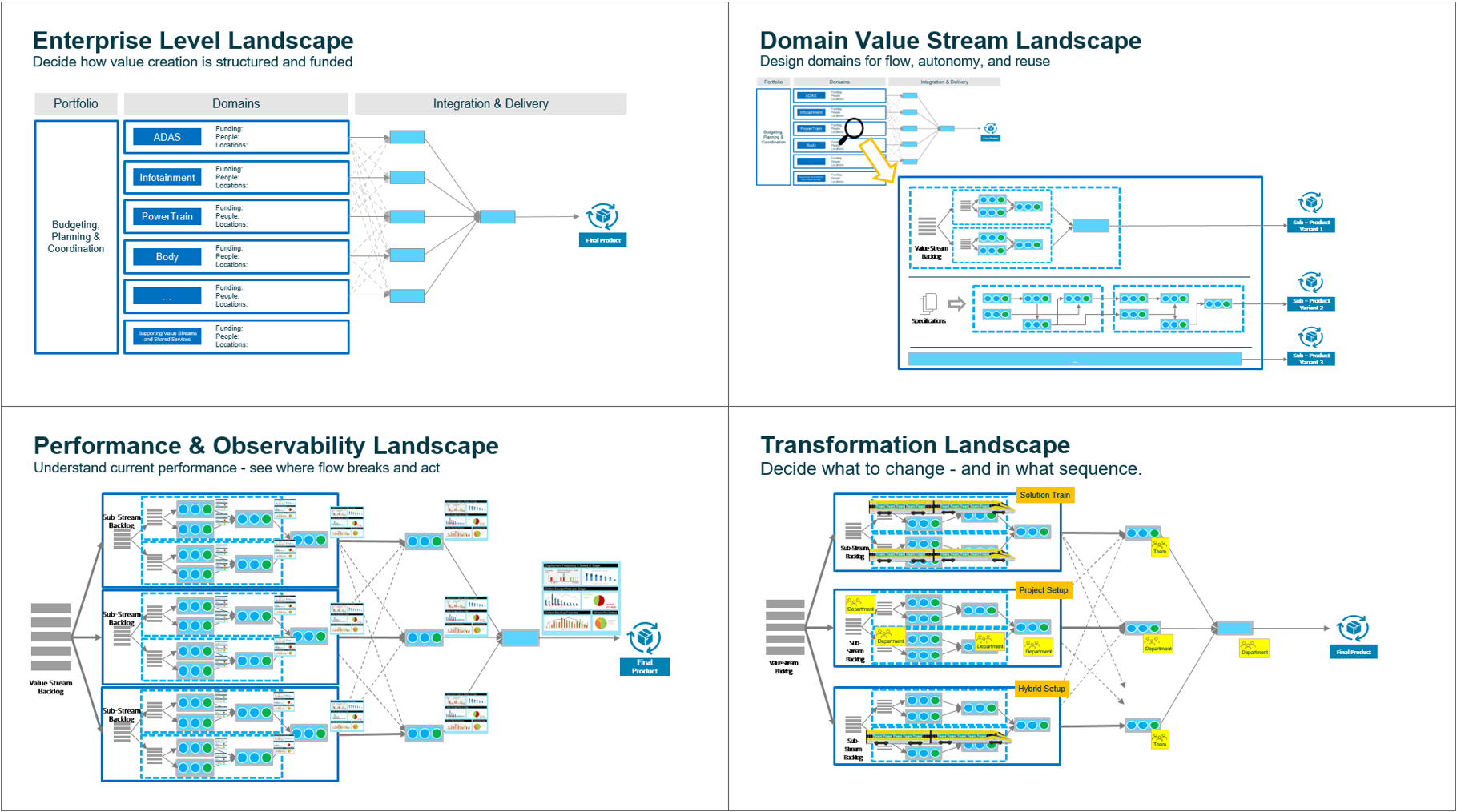
Different landscape views serve different decisions: an enterprise-level landscape clarifies structure and funding; a domain landscape exposes fragmentation and modularization opportunities; a performance and observability landscape reveals where flow breaks; and a transformation landscape shows what to change and in what sequence.
For a detailed exploration of landscape types and how to build them, see Value Stream Landscapes.
Conclusions
The Assembly Line Model provides a structured yet flexible way to represent how value flows in product development. It simplifies complexity without oversimplifying reality. The same model reveals structure, feedback, organizational alignment, and performance — depending on what needs to be understood. And because of its recursive nature, it scales from a single team’s workflow to an enterprise-wide landscape of interconnected value streams.
With the Assembly Line, organizations can see their value streams as living systems – measurable, improvable, and scalable – enabling faster learning, higher quality, and the continuous delivery of value to customers.
For a complete guide to applying the Assembly Line across the Value Stream Lifecycle – from identification through organizing around value to systematic optimization – see the Value Stream Thinking Overview.
Notes & References
- In such cases, we often refer to a value stream landscape — a structured network of interconnected value streams, each delivering a sub-product or capability. Together, these value streams contribute to the development and delivery of the overall solution, with each playing a defined role within the broader system. ↩︎
- Especially in automotive and other cyber-physical environments, this part is typically addressed through systems engineering and involves several additional dimensions that need to be considered. ↩︎
- In the real world, backlog assignment depends on the chosen team topology. For component teams (also known as complicated subsystem teams), there is often a 1:1 relationship between a team and its backlog. In contrast, for stream-aligned teams, a single backlog may span multiple parts of the system, reflecting their broader end-to-end responsibility. ↩︎
Author: Peter Vollmer – Last Updated on April 25, 2026 by Peter Vollmer