
Understanding, Designing, and Steering Value Streams at Enterprise Scale
Intro
Value Stream Landscapes provide a way to make complex value creation systems visible – not for documentation, but for steering.1
In large automotive development environments, value creation spans multiple domains, model series, variants, and technology generations. Structure, funding, architecture, delivery flow, and transformation dynamics interact continuously. No single representation can adequately explain or steer such a system.
Questions about enterprise structure require a different view than questions about domain productivity. Delivery performance demands a different perspective than structural evolution. Each class of decision requires a different modeling emphasis and level of abstraction.
Effective Value Stream Landscapes are therefore purpose-driven views of the same underlying system. They are not alternative realities – they are deliberate lenses designed to enable specific decisions.
To steer enterprise-scale development systems, four complementary perspectives are required:
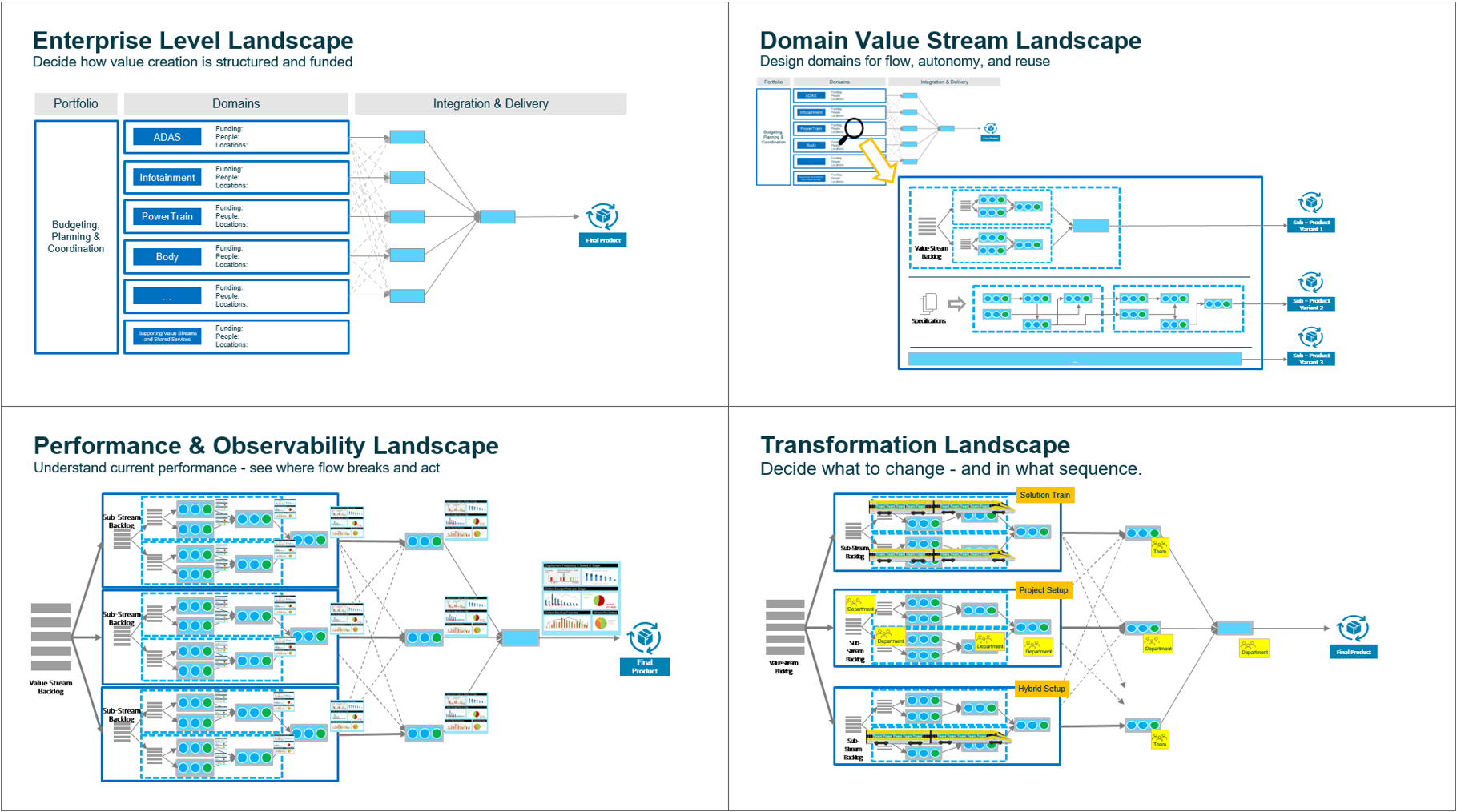
1 – Enterprise Level Landscape: Decide how value creation is structured and funded.
Makes structural and funding boundaries explicit – enabling enterprise design and economic alignment decisions.
2 – Domain Value Stream Landscape: Design domains for flow, autonomy, and reuse.
Reveals internal domain flow, parallel structures, and architectural constraints – enabling simplification and modularization decisions.
3 – Performance & Observability Landscape: See where flow breaks – and act.
Turns structure into observable system behavior – enabling evidence-based improvement and prioritization decisions.
4 – Transformation Landscape: Decide what to change – and in what sequence.
Makes structural asymmetries and mixed operating modes visible – enabling deliberate transformation steering.
Each perspective makes different relationships visible. None is sufficient on its own. Together, they provide the instruments required to structure, design, measure, and evolve complex development systems – enabling both systemic understanding and deliberate, future-oriented steering.
This article uses automotive development as a concrete example to demonstrate how these perspectives interact, and how Value Stream Landscapes move from descriptive diagrams to practical instruments for structural design, flow improvement, and deliberate transformation. Although the examples are rooted in automotive development, the structural logic and modeling principles are transferable to any complex, multi-domain product development system.
Clarifying Core Structures and Relationships
To avoid conceptual ambiguity, the core terms used in this article – Value Streams, Sub-Streams, Value Stream Landscapes, Nested Value Streams, and Value Stream Networks – are defined separately in the Value Stream Concepts and Definitions article.
To model automotive development meaningfully, we must first clarify structural levels and system boundaries. As a reference point, we use the end-to-end vehicle development system – from initial concept to start of production – across multiple model series and variants.2
Value Streams are recursive structures. A value stream may contain sub-streams, which may themselves contain further sub-streams. The distinction between them is not one of essence, but of scope, system boundary, modeling purpose, and degree of abstraction.
For clarity, this article uses the automotive OEM context as the enterprise boundary. At this level, we speak of an Enterprise-Level Value Stream Landscape – a structured system of interacting value streams that collectively enable vehicle development.
What is considered a product or a sub-product depends on this boundary. For an OEM, domains such as ADAS or Infotainment deliver sub-products that create market value only once integrated into a vehicle. For a supplier specializing in ADAS systems, the same system represents the final product. The object does not change – only the boundary and perspective do.
Because the enterprise-level development system is too complex to be understood as a single flow, it is decomposed into Domain Value Streams such as ADAS, Infotainment, or Powertrain. Each Domain Value Stream delivers a coherent domain-specific outcome that contributes to the overall vehicle system.
Within a Domain Value Stream, multiple internal value streams may exist. These implementation-level streams build and evolve the domain’s deliverables. They may be organized as coherent product-oriented flows – or as parallel, project-like structures driven by variants, generations, or vehicle programs.
Distinguishing between enterprise structure and internal domain implementation is essential. It separates questions of governance and system design from questions of architectural clarity, performance behavior, and structural evolution – a distinction that becomes central in the landscape perspectives introduced next.
Domain Value Streams as Essential Structural Units
Domain Value Streams are not merely internal building blocks of vehicle development. Each domain delivers its sub-products to multiple model series – often in parallel – serving different vehicle lines, programs, markets, and timelines.
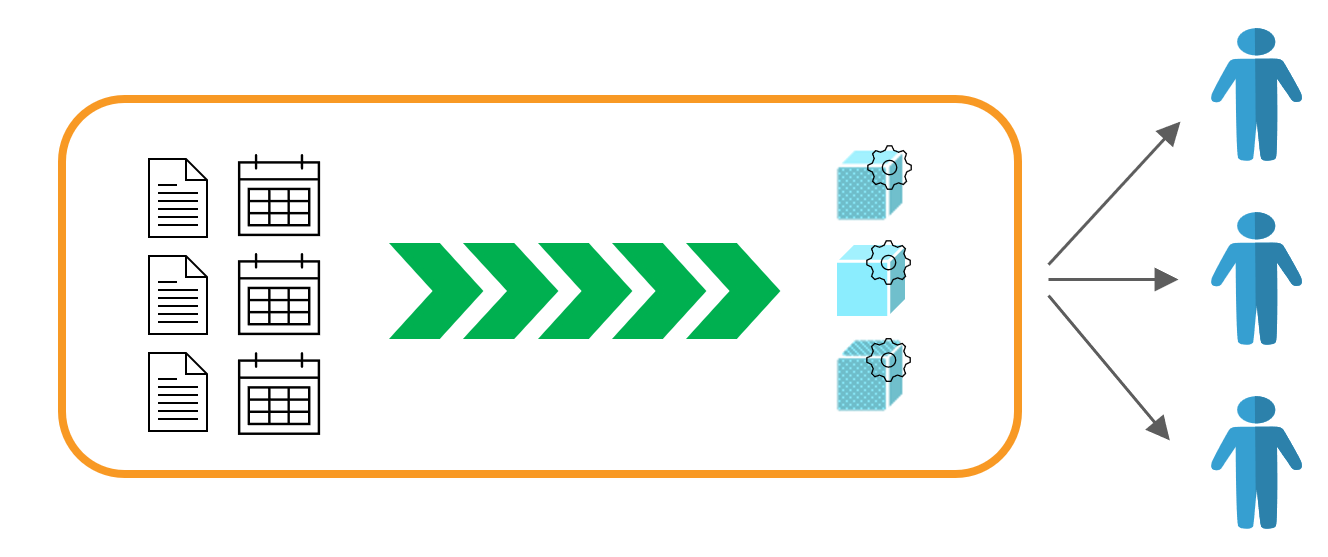
From the domain perspective, model series act as customers. They consume domain-specific sub-products, integrate them into a vehicle context, and drive demand for features, configurations, regulatory characteristics, and quality attributes. Although all ultimately contribute to delivering vehicles to the market, each model series represents a distinct demand stream with its own cadence and priorities.
A Domain Value Stream therefore operates in a networked environment – balancing multiple consumers while maintaining internal coherence and technical integrity.
Internally, however, the implementation of a Domain Value Stream can vary significantly. In an idealized case, a single coherent, product-oriented flow delivers all required variants of the domain sub-product. At the other extreme, variants or generations may be realized through separate, project-like flows – effectively creating parallel sub-streams with limited integration. Components may be shared or duplicated. Some elements may be developed internally, others heavily supplier-driven.
These differences are not accidental. They reflect deliberate – or historical – structural and organizational choices: product versus project orientation, platform consolidation versus variant fragmentation, long-lived teams versus temporary programs.
As a result, the internal design of a Domain Value Stream becomes a central architectural and organizational decision. It directly influences flow efficiency, reuse potential, coordination effort, and responsiveness to changing model-series demand.
From the outside, a Domain Value Stream may appear as a single provider serving multiple model series. Internally, however, it may consist of layered, parallel, or loosely connected structures. This distinction between external role and internal implementation becomes essential when analyzing domain-level flow and structural design.
Domain Value Streams are therefore value streams in their own right.3 They have a clear purpose, identifiable consumers, and a continuous flow of work spanning architecture, development, integration, validation, and ongoing evolution. How they appear – and how they are optimized – depends on the perspective from which they are viewed.
Perspective Matters: Nested and Networked Behavior
The same Domain Value Stream can appear differently depending on the modeling perspective.
When viewed from the perspective of a specific vehicle or model series, Domain Value Streams behave as Nested Value Streams – tightly aligned contributors within a larger end-to-end flow. Integration milestones, validation activities, and delivery cadence are synchronized around a shared vehicle outcome.
In this nested perspective, domain performance cannot be optimized independently – it must be understood in relation to overall vehicle delivery. Delays, quality issues, or rework in one domain directly affect the integrated system.
When viewed from the domain perspective, however, the same Domain Value Stream operates in a networked environment. It serves multiple model series in parallel, balances competing demand streams, and coordinates through defined interfaces rather than shared vehicle milestones alone.
These are not different systems. They are different perspectives on the same system. Understanding this shift in perspective is essential for steering. The model-series view highlights alignment, integration risk, and end-to-end delivery coherence.
The domain view highlights capacity balancing, reuse, architectural structure, and internal design decisions.
Understanding this shift in perspective is essential for steering. Without it, discussions about optimization become confused – mixing system-level alignment questions with domain-level structural design questions.
The detailed conceptual distinctions between Nested Value Streams and Value Stream Networks are explained in the Value Stream Concepts and Definitions article. Here, the focus remains on how these perspectives enable different steering decisions.
Each of the following landscapes isolates a different decision layer of the same system. They must not be mixed casually – but deliberately combined4. With these structural relationships clarified, we can now examine each landscape perspective in turn and explore the specific decisions it enables.
1 – Enterprise-Level Value Stream Landscape
Structure – How value creation is organized, funded and governed
The Enterprise-Level Value Stream Landscape provides structural orientation at the highest system boundary. It models how value creation is decomposed into Domain Value Streams, how responsibilities and funding are assigned, and how cross-domain coordination and system-level integration are organized.
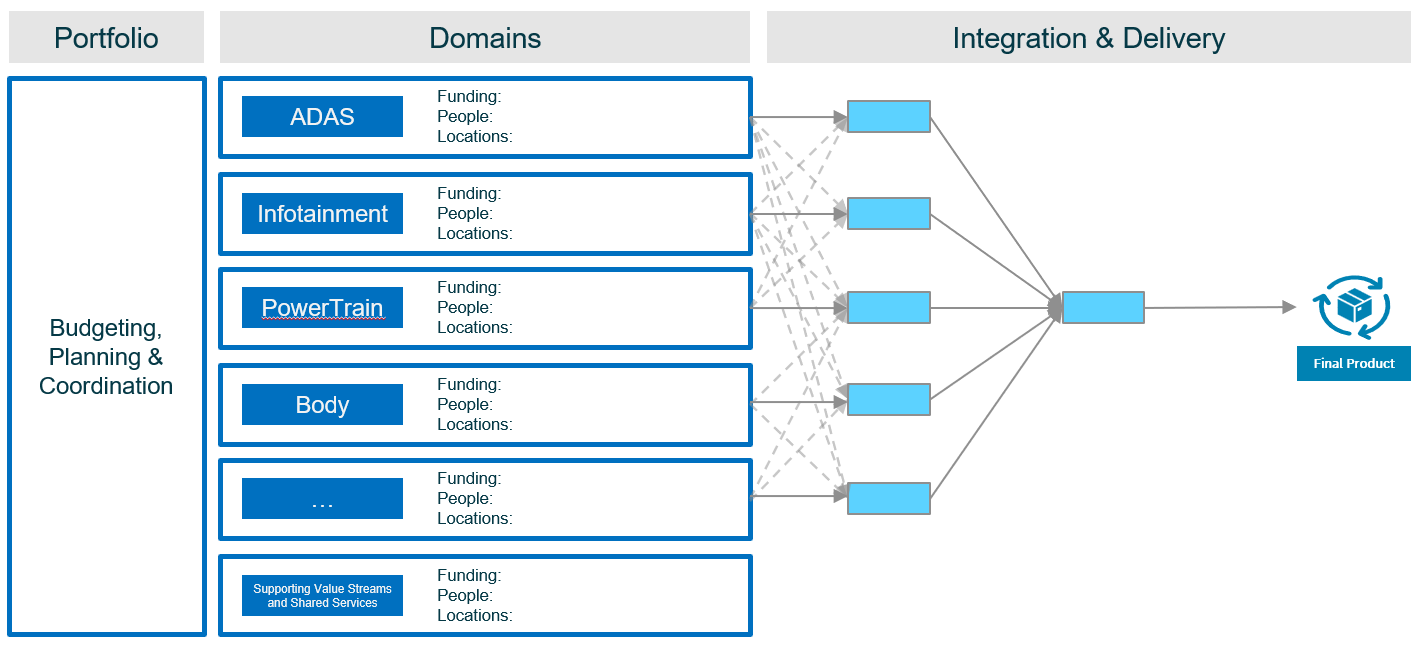
Its primary focus is structural design and governance transparency at enterprise scale. Operational flow performance is observed at domain and system boundaries – but also interpreted in the context of structural and funding design rather than local optimization. At this level, leadership answers foundational questions:
- Which Domain Value Streams exist?
- How are sub-products and responsibilities distributed?
- How are funding boundaries defined?
- Where does system-level integration and validation occur?
- How are cross-domain coordination and prioritization governed?
- What mechanisms align domains around a shared vision, roadmap, and strategic objectives?
In complex automotive environments, Domain Value Streams cannot operate in isolation. They must align around:
- A common product vision
- Shared system-level milestones
- Enterprise objectives (e.g., OKRs)
- Coordinated roadmaps
- Defined integration events
The Enterprise-Level Landscape makes these alignment and governance structures visible. It clarifies where decision authority resides, how priorities are synchronized across domains, and how integration is steered at system level. By making structural, economic, and governance boundaries explicit, this perspective exposes systemic misalignments that often remain hidden – such as:
- Domains funded in ways that contradict their multi-program obligations
- Integration responsibility without clear ownership
- Strategic objectives that lack structural anchoring
- Coordination mechanisms that depend on informal negotiation rather than defined governance
This perspective enables enterprise design and governance decisions, including:
- Defining or reshaping Domain Value Streams
- Aligning funding models with structural responsibilities
- Clarifying integration and system validation ownership
- Establishing coordination and prioritization mechanisms across domains
- Anchoring vision, roadmap, and objectives structurally
Importantly, this landscape does not analyze flow mechanics at stage or team level. It interprets performance at enterprise scale in order to assess structural effectiveness, funding alignment, and governance design.
From this perspective, leadership can identify patterns such as:
- A Domain Value Stream becoming a systemic performance bottleneck
- A domain consistently missing integration commitments
- Funding levels that are disproportionate to delivered outcomes
- Structural fragmentation driving recurring cross-domain friction
- Domains consuming significantly more resources than comparable peers
To enable such evaluation, the Enterprise-Level Landscape depends on an appropriate measurement system that provides cross-domain observability. Aggregated flow metrics, outcome indicators, and integration reliability signals make structural effectiveness visible at enterprise scale. Without this observability architecture, governance decisions risk becoming opinion-based rather than evidence-informed. The detailed design of such measurement systems is described in the Value Stream Measurement and Metrics Guidance articles.
Without this structural baseline, downstream discussions about productivity, bottlenecks, or transformation lack context. With it, enterprise leadership can deliberately shape the system rather than react to its symptoms.
2 – Domain Value Stream Landscape
Design – How domains are architected for flow, autonomy, and reuse.
The Domain Value Stream Landscape provides structural orientation inside a specific domain. It models how internal value streams are organized, how work is decomposed into sub-streams, how variants and generations are handled, and how architecture, reuse, and supplier contributions shape internal flow.
Its purpose is not enterprise alignment or funding governance. Its purpose is architectural and structural clarity within the domain.
Large domains may themselves contain sub-domains. The same structural relationship that exists between Enterprise and Domain can also exist between Domain and Sub-Domain. The modeling logic remains the same – only the boundary and level of abstraction shift.
At enterprise level, a Domain Value Stream appears as a coherent provider within the overall vehicle development system. At domain level, its internal implementation becomes visible. A domain may consist of:
- A single coherent product-oriented flow
- Multiple parallel value streams driven by variants or generations
- Project-based overlays tied to vehicle programs
- Architectural layers operating at different cadences
- Supplier-driven sub-streams integrated into internal flow
The Domain Value Stream Landscape makes these internal structures explicit.
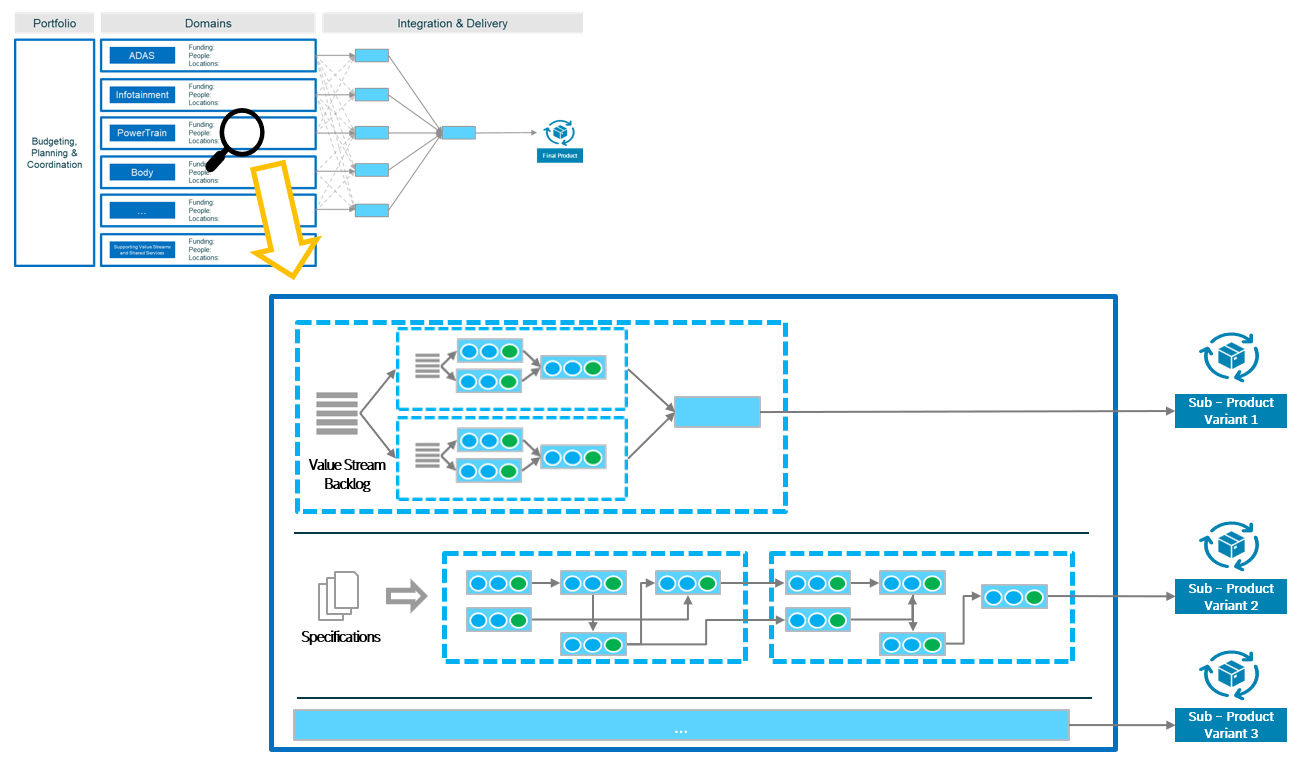
At this level, domain leadership answers foundational questions:
- How is work structured inside the domain?
- Are we organized around long-lived products or temporary projects?
- How many parallel streams exist for variants or generations?
- Where do architectural boundaries enable or constrain autonomy?
- Where is reuse systematic – and where is duplication emerging?
- How do supplier contributions integrate into internal flow?
By making internal structures visible, this perspective exposes patterns that directly influence productivity and sustainability, such as:
- Fragmentation across parallel variant streams
- Project-based implementations interrupting product continuity
- Architectural coupling that limits team autonomy
- Redundant solution development across generations
- Supplier interfaces that increase coordination complexity
This perspective enables architectural and structural design decisions, including:
- Consolidating parallel streams into coherent product-oriented flows
- Reducing variant-driven fragmentation
- Clarifying architectural ownership and modular boundaries
- Increasing reuse through platform enablement and modularization
- Aligning team structures with value-aligned flow
Without this internal clarity, improvement efforts often target symptoms rather than structural causes. With it, domain leadership can deliberately design for flow, autonomy, and long-term maintainability instead of inheriting historical complexity.
Structured Value Stream Landscape Identification workshops provide a systematic way to uncover and model internal domain structures – turning implicit boundaries into explicit design decisions.
3 – Performance & Observability Landscape
Measure – How flow performance becomes observable and steerable.
The Performance & Observability Landscape makes system behavior visible. It builds on the structural foundations established by the Enterprise-Level and Domain Value Stream Landscapes and turns them into measurable, comparable flow dynamics.
Its purpose is not structural design or architectural clarity. Its purpose is to make end-to-end flow observable at system level – and therefore steerable.
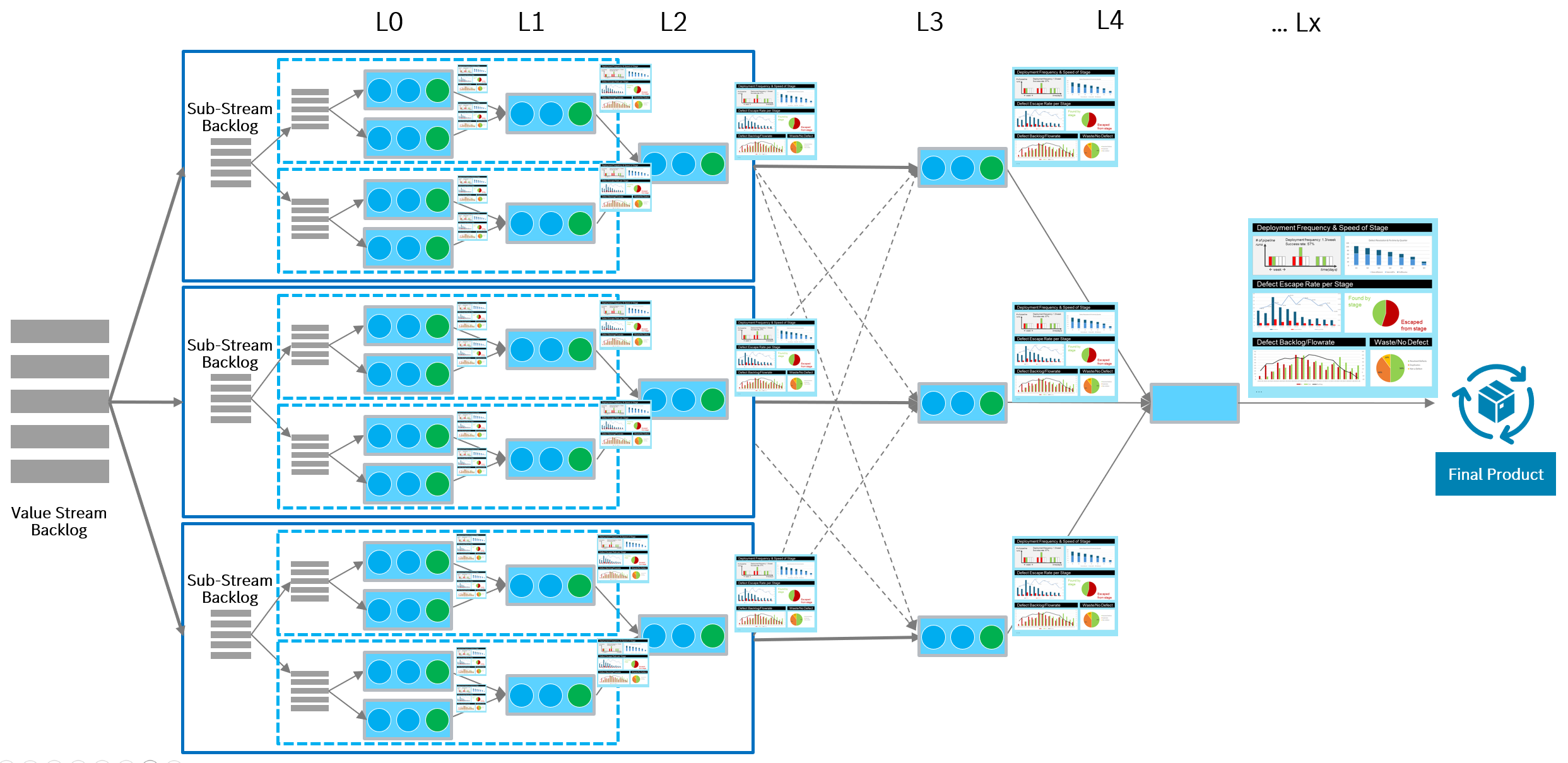
At the core of this perspective is the Assembly Line modeling approach. While the articles How to Start – Single Value Stream and Using the Assembly Line Approach for Value Stream Optimization describe this method for an individual value stream, this landscape applies the same logic across a broader scope – typically at the level of a full model series or major development segment.
Sub-stream analyses are not replaced – they are aggregated. Individual value stream insights are combined into a coherent landscape that reveals how work flows across domains, where integration slows down, and where structural design choices manifest as systemic constraints.
From Structure to System Behavior
This landscape models how work moves over time and where flow degrades due to:
- Queues and excessive work-in-progress
- Late integration and delayed feedback
- Handovers across architectural boundaries
- Defect escape and downstream rework
- Coordination overhead across domains
Unlike the structural landscapes, which describe how the system is organized, this perspective reveals how the system behaves.
The Observability System
Flow observability does not emerge automatically. It requires a deliberately designed measurement system anchored to:
- Value stream stages
- Integration points
- Feedback cycles
- Quality signals
- Flow performance parameters
By decoupling measurement from organizational units and anchoring it to value streams and integration logic, performance becomes comparable even when structures differ.
At this level, leadership and delivery owners answer questions such as:
- How long does it take for work to flow end to end?
- Where does flow break or become unpredictable?
- Which stages or integration points act as systemic bottlenecks?
- Where does rework originate, and where is it detected?
- Which domains or variants behave as systemic constraints?
Optimization as a System
The illustration below captures the core logic of this perspective.
OKRs define intent and set the direction for optimization. The visualized value stream or landscape (Assembly Line Model) then makes structure and flow explicit as one integrated system. A supporting measurement system provides observability, allowing behavior to be understood rather than assumed.
Based on this shared view, Value Stream Optimization Leads model, analyze, and improve the system. Structural improvements reshape flow behavior, and emerging performance signals expose the next systemic constraint. As the system evolves, refinements in the measurement approach increase observability, which in turn enables more precise optimization decisions.
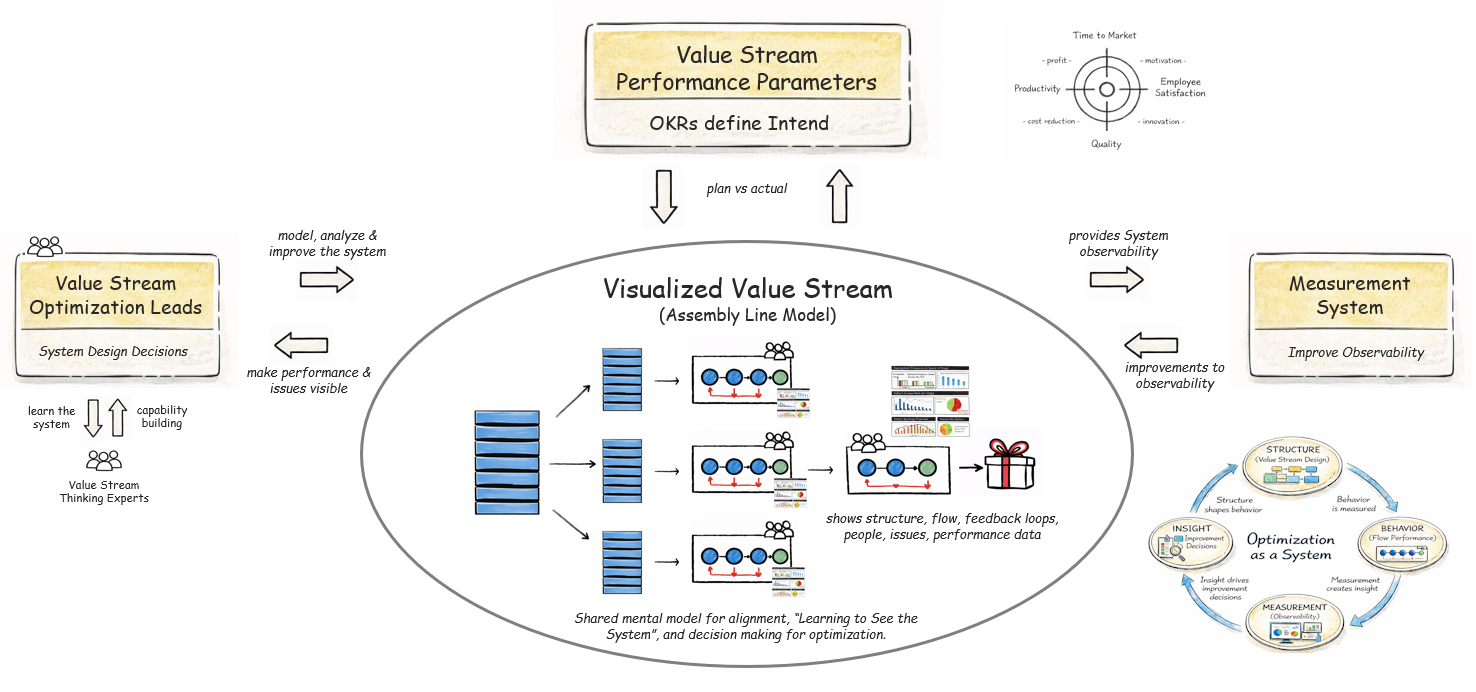
The small closed-loop diagram in the bottom-right highlights the systemic nature of value stream optimization. Structure shapes behavior, behavior becomes observable through measurement, and insights are translated into improvement decisions that reshape the system. Optimization therefore operates as a continuous learning loop rather than a sequence of isolated improvements.
At this level, performance signals are not used for local optimization. They are used to understand systemic effectiveness and guide structural refinement.
Without this perspective, optimization remains local and anecdotal5 – often reinforcing structural bottlenecks instead of resolving them. With it, flow becomes a shared, observable system property that enables deliberate, evidence-based steering..
4 – Transformation Landscape
Evolve – How structural change is deliberately sequenced and prioritized.
The Transformation Landscape provides a time-based view of the development system. It builds on the structural clarity of the Enterprise-Level Landscape, the internal design insight of the Domain Value Stream Landscape, and the behavioral transparency of the Performance & Observability Landscape.
At its core, it connects organizational evolution with system architecture – recognizing that architectural structures both enable and constrain flow, autonomy, and long-term organizational design.
Its purpose is not to describe structure or performance in isolation. Its purpose is to make structural evolution visible and steerable by showing how the current structure creates both constraints and opportunities for change — and in which sequence adjustments are most effective.
In doing so, it also makes transformation progress visible over time, especially when combined with a transformation roadmap that reflects intended structural shifts and architectural evolution.
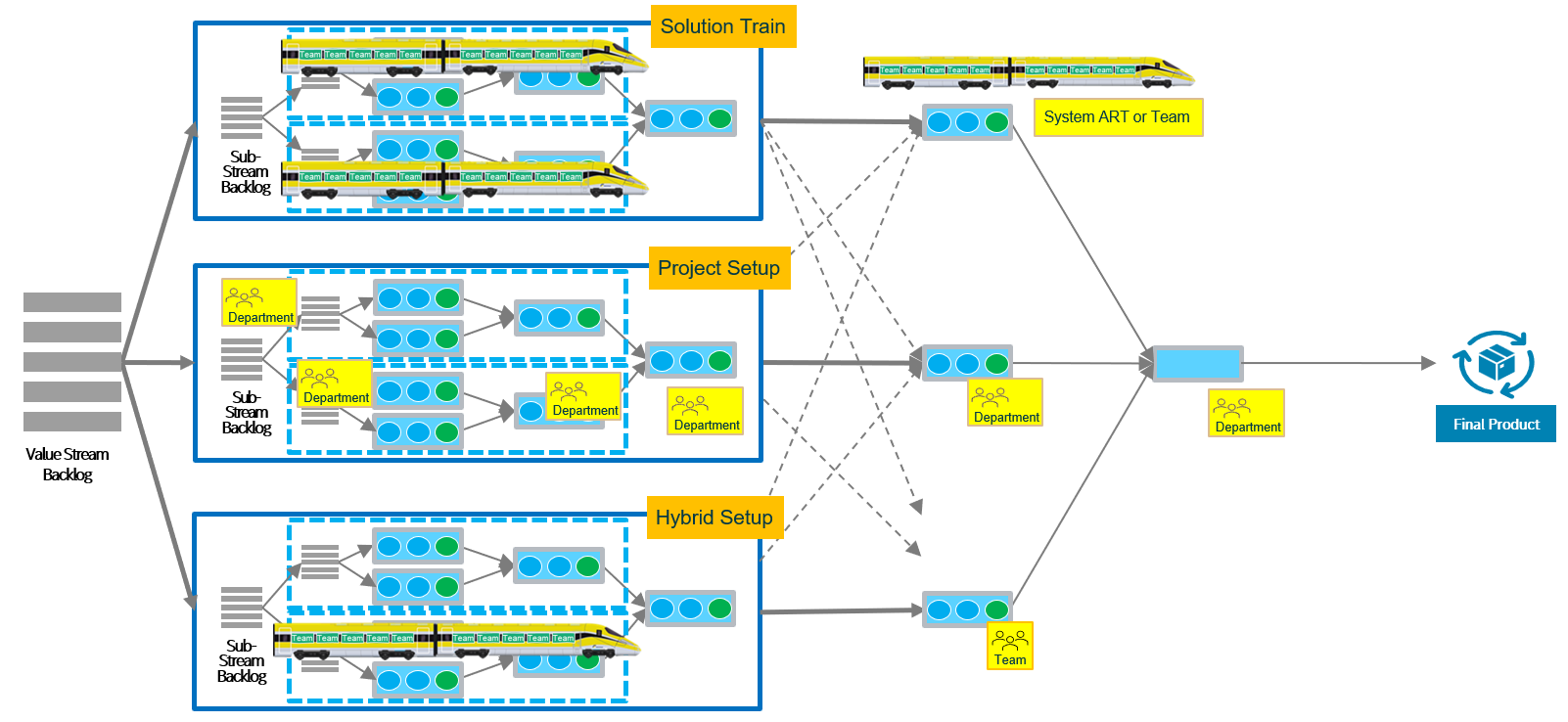
In complex automotive environments, transformation rarely happens uniformly. Different domains, streams, or architectural layers often operate in different modes at the same time. Some areas may be product-oriented and platform-based, others still project-driven or variant-fragmented. New architectures may coexist with legacy generations. Supplier models may differ across sub-streams. The Transformation Landscape makes these structural asymmetries explicit.
At this level, leadership answers questions such as:
- Where is the system structurally stable – and where is it in transition?
- Which domains operate in mixed modes that create coordination friction?
- Where do legacy structures constrain flow or autonomy?
- Which structural adjustments have the highest systemic leverage?
- In what sequence should changes be introduced to minimize disruption?
This perspective exposes patterns such as:
- Product-oriented domains interacting with project-driven domains
- Consolidated platforms coexisting with fragmented variant streams
- Misaligned cadences between evolving and legacy areas
- Architectural modernization that outpaces organizational adaptation
By making these dynamics visible, this landscape enables deliberate transformation decisions, including:
- Articulating and aligning on future structural target states
- Exploring alternative structural scenarios and transformation paths
- Sequencing structural changes across domains
- Consolidating or redefining Domain Value Streams
- Shifting from project-based to product-based operating models
- Rebalancing responsibilities, ownership, or sourcing strategies
- Coordinating architectural evolution with organizational change
Without this perspective, transformation remains reactive and localized. With it, structural change becomes intentional, sequenced, and system-aware.
The Transformation Landscape does not enforce a single target operating model. Instead, it provides a shared map of the system’s evolutionary state – enabling leadership to articulate desired future states, explore structural scenarios, and steer transformation iteratively through informed sequencing rather than linear planning.
Conclusion: Steering with Intent
Enterprise-scale development systems cannot be understood or steered through a single representation. Structure, architecture, flow behavior, and transformation dynamics interact continuously – and each requires a different lens.
Value Stream Landscapes provide these lenses. The Enterprise-Level Landscape clarifies structural and governance foundations. The Domain Value Stream Landscape reveals how internal architecture shapes flow and autonomy. The Performance & Observability Landscape turns structure into observable system behavior. The Transformation Landscape adds a time dimension, making evolution, future states, and sequencing visible.
Used together, these perspectives shift Value Stream Landscapes from descriptive artifacts to practical steering instruments. They enable leadership to move beyond isolated optimizations and instead reason about systems holistically — connecting structure, behavior, and evolution.
Importantly, transformation at this scale is neither linear nor uniform. Different parts of the system evolve at different speeds, architectural layers shift asynchronously, and organizational change follows iterative learning cycles. Landscapes provide the shared mental model needed to navigate this complexity – enabling informed discussions about target states, structural scenarios, and sequencing decisions.
Ultimately, the value of Value Stream Landscapes lies not in visualization itself, but in the conversations and decisions they enable. They allow organizations to see their systems clearly, reason about them coherently, and evolve them deliberately – turning complexity from a source of friction into a domain of intentional design.
Notes & References
- Value Stream Landscapes create a shared mental model that allows people to see how value flows through organizations. They identify individual sub-streams, their contributions, and the hand-offs and integrations between them. By visualizing the system, they support understanding and alignment across stakeholders. Based on this shared view, aspects such as responsibilities, funding, relationships, dependencies, and performance can be made explicit and discussed. ↩︎
- This enterprise boundary is selected intentionally to maintain conceptual clarity and keep the discussion focused on steering concerns. ↩︎
- Domain Value Streams can be understood similarly to product lines in other industries. Just as a product line delivers multiple variants of a product, a Domain Value Stream delivers multiple variants of a domain-specific sub-product within the broader vehicle value stream(s). Consequently, many modeling, design, and transformation concepts and approaches applicable to product lines can also be meaningfully applied to Domain Value Streams – and vice versa. ↩︎
- In large organizations, tensions between perspectives are often reinforced by structural incentives. Leaders responsible for a specific model series are naturally incentivized to optimize delivery performance within that series. Domain owners, by contrast, are incentivized to optimize reuse, architectural coherence, and cross-series capacity balancing.
These incentives can also influence boundary discussions. Domains may argue for expanding or retaining responsibility for certain sub-products on architectural or efficiency grounds. Without explicit modeling of value streams and system boundaries, such discussions can easily become political rather than structural.
Making perspectives and boundaries explicit helps separate legitimate design trade-offs from incentive-driven positioning and enables decisions based on system logic rather than local optimization. ↩︎ - Anecdotal refers to optimization driven by isolated experiences or local observations rather than observable, system-level flow data. ↩︎
Author: Peter Vollmer – Last Updated on Februar 16, 2026 by Peter Vollmer