
Why Value Stream Thinking?
This article outlines the rationale behind Value Stream Thinking and identifies the key enablers for applying it successfully within product development.
“Whenever there is a product for a customer, there is a value stream. The challenge lies in seeing it.”
– Mike Rother and John Shook, Learning to See 1
The Organizational Challenge
In many organizations, delivering value at the required speed and responding quickly to evolving market needs remains a systemic challenge. Legacy structures and siloed responsibilities create disjointed workflows that hinder alignment and collaboration. Project-based thinking overloads capacity, spreads individuals across too many initiatives, and slows down decision-making.
These challenges are even more acute in complex, software-intensive and cyber-physical environments such as automotive or aerospace. With large numbers of engineers and suppliers distributed across systems and sites, organizations lack a systematic way to visualize and optimize end-to-end value delivery. The result is inefficiency, slow responsiveness, and persistent misalignment between structure and value flow.
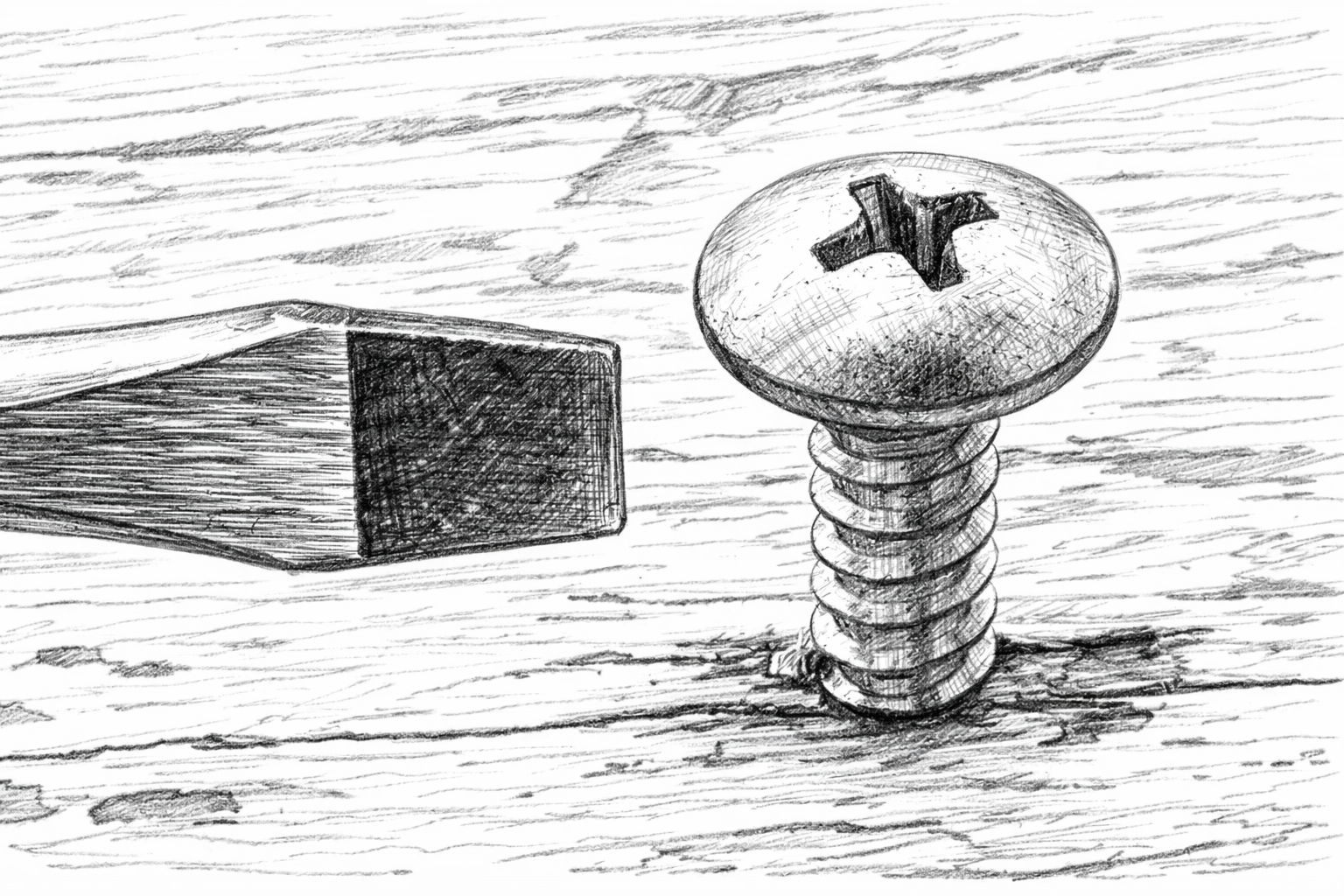
Traditional value stream methods, adapted from manufacturing, can be applied to product development — but often feel like using a flat-head screwdriver on a Phillips screw. You can make progress, but it takes more effort, is less precise, and the results are rarely optimal. Product development is not a linear, repeatable process; it is iterative, exploratory, and driven by learning cycles. Without the right tool and perspective, organizations struggle to see the real flow of value, spend more time than necessary on modeling and optimization, and miss timely, impactful improvements.
The Promise of Value Streams
To meaningfully discuss value streams, we first need clarity about what they are and how they function. The formal definitions and structural relationships underlying Value Streams are described in detail in the Concepts and Definitions article. Here, we focus on the promise they hold.
As Peter Senge describes in The Fifth Discipline2, teams operate based on shared mental models – internal representations of how things work. When these models are misaligned, so is action. Value Stream Thinking provides a shared lens across roles and departments, making the end-to-end flow of work visible – including the handoffs, delays, feedback loops, and integration points that often remain implicit.
As Rother and Shook emphasize, value streams are always present, even when they are not explicitly recognized. In many organizations, knowledge about the stream is fragmented: each team sees its part, but no one sees the whole. This invisibility leads to misaligned decisions, local optimization, duplicated effort, and systemic friction.
Improving how an organization delivers value does not begin with new tools or more metrics. It begins with making the value creation system visible. A shared understanding of how value flows across the system enables better decisions, faster learning, and more coherent collaboration.
In short: you can’t improve what you don’t understand – and understanding begins with seeing the system clearly, from individual value streams to the broader landscape of how they interconnect across the organization.
What Is Value Stream Thinking?
Value Stream Thinking (VST) makes the end-to-end flow of value visible, modelable, measurable, and continuously improvable – enabling people at every level to understand the system and steer it toward better flow and outcomes.
It does not replace lean principles, agile practices, DevOps concepts, Team Topologies, or leadership. Rather, it provides the system perspective within which these practices align and reinforce one another. Without understanding how value flows across teams, domains, and system boundaries, local improvements risk optimizing parts while the overall system remains constrained.
Breakthroughs in complex systems rarely come from more data alone. They come from choosing a model that makes structure and causality visible. The way we represent a system determines what we are able to see – and what we are able to see determines the decisions we make.
Modern organizations are not short of dashboards, metrics, or transformation initiatives. What they often lack is a model that reveals how value actually flows – where it slows down, where it fragments, and how structural design decisions influence performance.
The Assembly Line Model serves this purpose. It is not a manufacturing metaphor, but a modeling approach suited to reveal integration points, feedback loops, dependencies, and performance dynamics in complex product development systems. It allows organizations to zoom from enterprise landscapes down to individual sub-streams while maintaining a coherent view of the whole.
Seeing enables understanding.
Understanding enables deliberate, decentralized steering.
Value Stream Thinking therefore goes beyond identification and mapping. It enables organizations to design and steer their value creation system as a coherent whole.
The Advantage of Value Stream Thinking
Traditional value stream mapping approaches originated in manufacturing and operational environments, where flows are relatively stable, predictable, and repeatable. In such contexts, linear representations of work are often sufficient.
However, modern product development — especially in software-intensive and complex system environments — behaves differently. Work is iterative, integration-heavy, feedback-driven, and continuously evolving. Linear mapping approaches struggle to capture these dynamics, often oversimplifying what is inherently systemic.
Value Stream Thinking addresses this challenge by using a modeling approach suited to complexity.
At its core lies the Assembly Line Model. It provides a practical and scalable way to represent value creation across multiple levels of abstraction. You can zoom in to analyze a specific workflow, zoom out to understand how streams connect within a broader landscape, and continuously refine the model as new insights emerge. This flexibility creates a consistent language for understanding and improving value delivery across the organization.
Compared to traditional methods, VST brings several distinct advantages:
- Starts simple, grows as needed – Begins with a clear structural backbone and expands only when additional detail adds value.
- Scales across levels – From individual value streams or sub-streams to enterprise-wide landscapes of interconnected systems.
- Matches the nature of product development – Explicitly captures feedback loops, integration points, iteration cycles, and evolving system boundaries.
- Adapts abstraction deliberately – Enables zooming in for operational insight or zooming out for systemic integration without losing coherence.
- Minimizes participant effort – uses shorter, outcome-driven sessions that maximize stakeholder expertise while maintaining alignment.
- Reduces modeling overhead – Requires significantly less effort to build and maintain than traditional value stream maps, enabling faster learning cycles.
- Focuses on outcomes and flow – Measures performance at the stream level, emphasizing systemic constraints rather than individual output.
- Measures the stream, not the people – highlighting systemic issues rather than individual blame, enabling leaders to create the right environment for success.
- Enables decentralized steering – Makes system dynamics visible so that teams and leaders can make informed decisions without relying on centralized control.
- Integrates Lean, Agile, and DevOps principles – Accelerating feedback, organizing around value, and fostering continuous improvement within a coherent system view.
- Supports adaptive scaling – Allowing collaboration models and team constellations to evolve as demand changes, including co-intelligent collaboration with AI-enabled systems.
With these characteristics, Value Stream Thinking does more than visualize value creation. It provides a coherent system view that bridges strategy, structure, and execution – enabling organizations to deliberately design and evolve how value flows.
Conclusion
Seeing the system is only the beginning. Once value flow becomes visible, the next question inevitably follows: how should the organization be designed to support that flow?
Improving performance sustainably requires more than better visualization. It requires aligning structures, responsibilities, and collaboration patterns with the way value actually moves through the system. Organizing around value, designing team interactions deliberately, and enabling decentralized decision-making are natural consequences of understanding the flow.
Value Stream Thinking therefore does not stop at modeling. It provides the foundation for designing organizations that are coherent, adaptive, and capable of continuous improvement – across teams, domains, and enterprise landscapes.
Notes & References
Author: Peter Vollmer – Last Updated on Februar 19, 2026 by Peter Vollmer