
Value Stream Identification
This article introduces the concept of Value Stream Identification (VSI) and explains how it helps organizations gain clarity about how value is delivered. It outlines practical tools like the Value Stream Canvas and the Assembly Line Model, and emphasizes why simply visualizing a value stream is not enough.
“When you improve a system, start by making the work visible.” – Gene Kim
Describing a Value Stream
As already discussed in the article Why Value Stream Thinking, it is essential to define what a value stream actually is and ensure a shared understanding among stakeholders before attempting to identify them.

For a formal definition and a more detailed discussion of value streams, see the Concepts and Definitions article.
The formal definition and common conceptual representations provide an initial sense of what a value stream is, but they do not provide enough guidance for practical identification.
Why We Model
“Once we see the relationship between structure and behavior, we can begin to understand how systems work, what makes them produce poor results, and how to shift them into better behavior patterns.”
– Donella H. Meadows, Thinking in Systems: A Primer
A Value Stream Identification is usually prompted by something concrete. Often it is behavior: lead times that are too long, integration problems that surface late, quality issues that appear only at the end, teams that are fully utilized while delivery still slips. Just as often it is a pending change to the structure – a reorganization, an architectural shift, a new technology, a merger – where the question is not what went wrong but what the new arrangement will produce.
Both lead to the same place. Behavior is produced by the way the system is structured – how work is decomposed, where integration happens, who decides what, and where the boundaries between teams and domains are drawn. The difficulty is that structure is not visible. The organizational chart shows reporting lines, not the flow of value. Process descriptions show intended sequences, not the dependencies, queues, and feedback loops that actually determine behavior. Everyone experiences the behavior; what produces it stays hidden.
Structure is hidden in a second way as well. Meadows calls it bounded rationality: people decide on the information available from where they stand, and that information is always partial and often late.1 A component team sees its own backlog, its build, and the interfaces it is asked to honor. An integration lead sees what arrives late and what fails on assembly, not why it was late upstream. A domain owner sees commitments across programs and the escalations that reach them, not the queues that produced those escalations. Each view is accurate and each conclusion is sound. None of them is a view of the system, and locally rational decisions aggregate into behavior nobody chose. This is also why the problem is rarely one of judgment: put different people in the same positions and they will mostly reach the same conclusions. This is structure shaping behavior seen from the inside: what a position affords determines what the person in it can reasonably conclude.
This is why identification begins with a model. A model does not document a value stream – it makes its structure visible, so that the relationship between structure and the observed behavior can be examined. That is what turns a list of complaints into a diagnosis, and what makes it possible to decide deliberately, rather than intuitively, where to intervene. It is also why identification is done with people from across the stream rather than by an analyst working from documents: the overview has to be assembled from positions, because it exists in none of them.
Modeling is the first of the four moves described in Why Value Stream Thinking? – Value Stream Identification covers that first move and prepares the second, where the structure itself changes.
Value Stream Identification
To move from abstract understanding to practical application, we will first clarify what Value Stream Identification involves, and then outline which information and representations are most suitable for identifying a value stream effectively.
Value Stream Identification (VSI) is the structured process of discovering, defining, and scoping value streams within an organization. It clarifies:
• What products, services, or capabilities are delivered
• Who the customers are
• How value flows from idea to realization
The identification normally also includes a new setup that is organized around value as starting point for a successful further optimization.
Discovering means exploring where value is currently being delivered, moving beyond organizational charts to uncover the real flows of work and value.
Scoping means selecting a meaningful slice of work – big enough to deliver recognizable value, yet small enough to model, discuss, and improve effectively. These slices, called Value Streams, together form the bigger Value Stream or Value Stream Landscape.
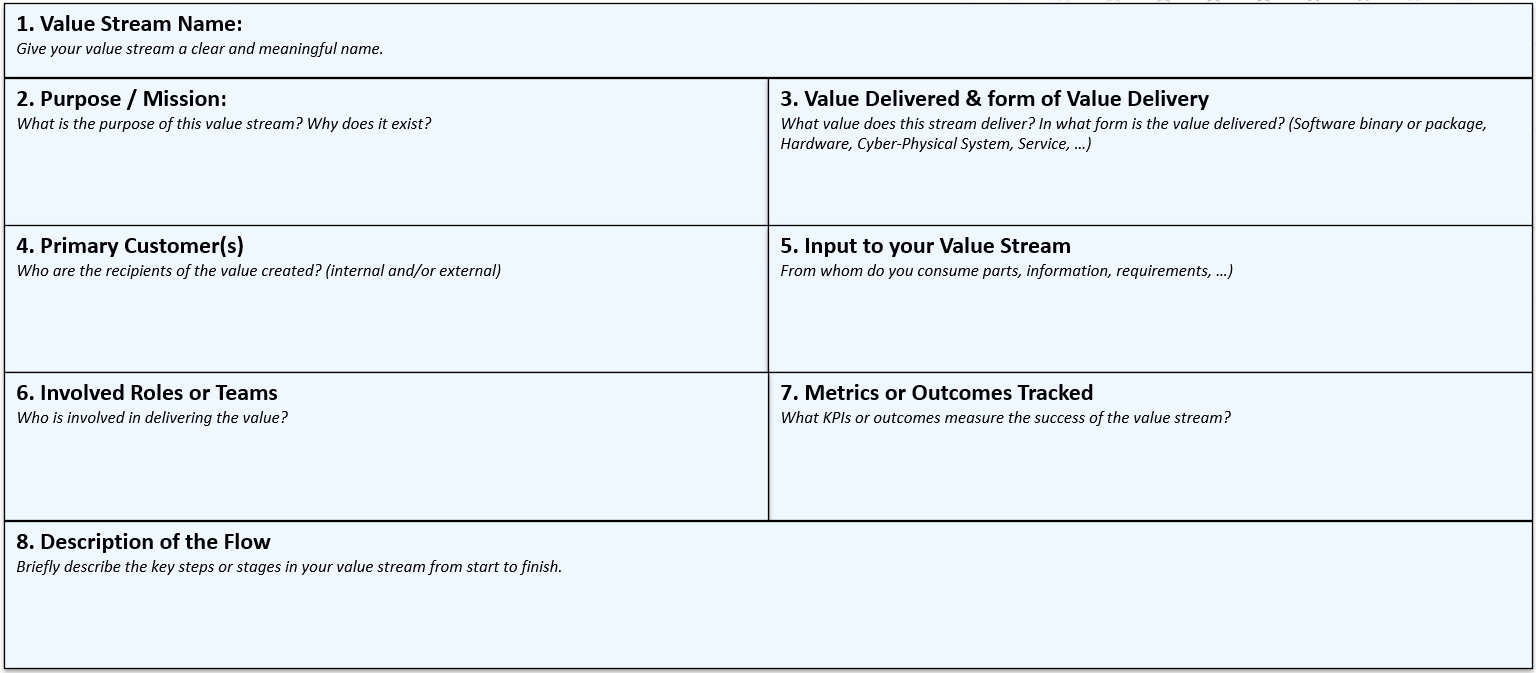
Defining is done with the Value Stream Canvas, which makes the stream explicit by capturing its purpose, customers, and end-to-end activities in a concise, structured way.
The purpose of a VSI is to provide the necessary understanding of the current value stream as the foundation for:
- Organizing around value to reduce lead time, and to maximize flow, quality and productivity (effectiveness and efficiency)
- Building the Value Stream Landscape in larger contexts
The major outcomes of a VSI are:
- Value Stream Canvas: capture major attributes of the value stream (one page description)
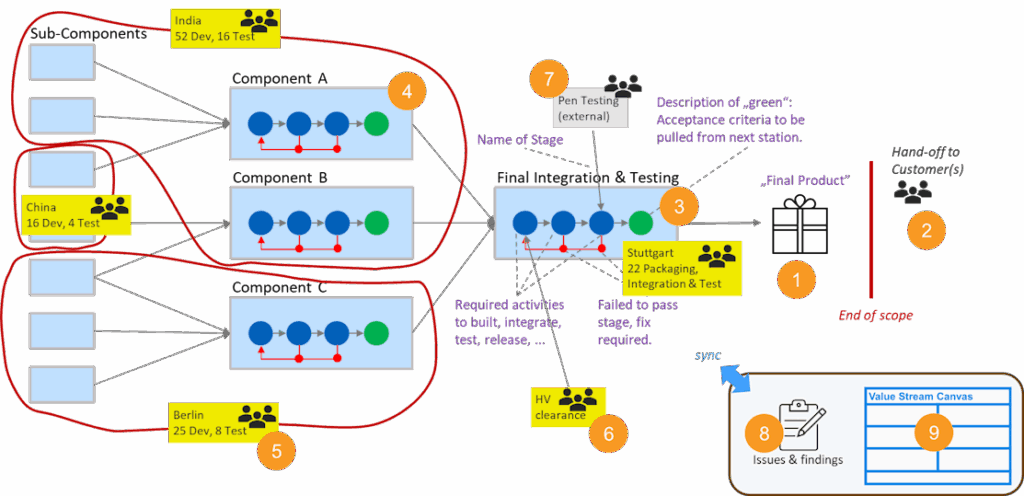
- Assembly Line Model: visualize the flow of work and the people involved
- Issues & Findings List: identify strengths, weaknesses, and opportunities for improvement
The Value Stream Canvas
A practical way to describe a value stream is through the Value Stream Canvas. Like any canvas, its purpose is to present a clear, concise, and structured view – in this case, of the development value stream. It captures the essential elements in a format that fosters alignment, improves communication, and enables actionable insights.
The Assembly Line
The Assembly Line is a visual model of the value stream that shows its flow, value creation, and key roles across all stages, including handoffs to the customer. It extends the canvas, provides the basis for the Issues and Findings List, and serves as the central model for systematic, continuous improvement throughout the value stream’s lifecycle. The process of creating an Assembly Line is described in the article Using the Assembly Line Approach for Value Stream Identification.
The Issues & Findings List
To fully understand a value stream, it is important to capture not only its strengths but also its current issues, as these insights shape the urgency to re-setup and optimize. During Value Stream Identification activities, such issues and observations inevitably surface. To keep the identification process focused, they are documented in a structured Issues and Findings Table rather than discussed at length on the spot. Each entry records the issue or finding, its scope, the area of the Assembly Line where it occurs, the impact in terms of flow, lead time, productivity, or quality, and the relevant expert or contact. Locating each finding on the Assembly Line is what connects observed behavior to the structure that produces it – and what turns a collection of complaints into a diagnosis. This approach ensures that valuable insights are not lost, while avoiding premature problem-solving or side discussions. The table is refined over time and becomes a key input for future-state proposals, where setup options are assessed against their ability to address the identified issues.
The Value Stream Identification Process
The quality of a Value Stream Identification outcome depends greatly on the process used. We recommend the following process for conducting an effective and efficient identification. The end-to-end steps are outlined in the article How to Start – Single Value Stream, and for orientation the process diagram is shown below.
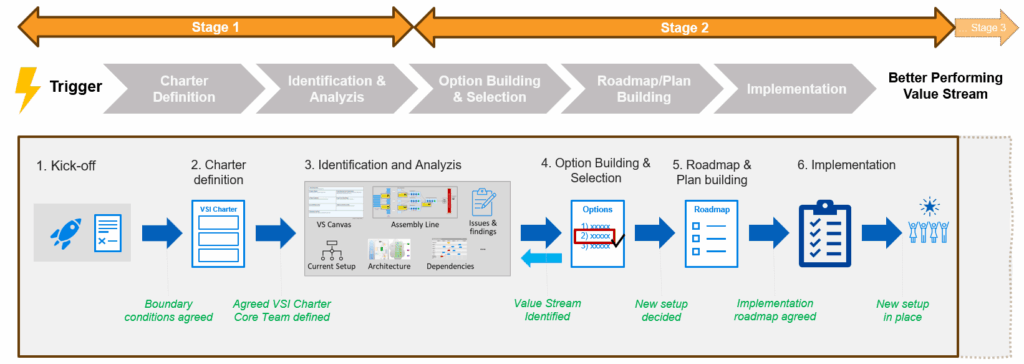
The relationship between structure and behavior runs through the whole process:
Kick-off and Charter establish why the value stream is being examined. Sometimes the trigger is behavior: lead times, late integration, recurring quality problems. Sometimes it is a change to the structure itself – a reorganization, an architectural shift, a new technology, a merger. Either way, the charter names what the identification has to answer, and both cases lead to the same question: how does the structure of this system produce the behavior we see, or the behavior we will get?
Identification and Analysis first bounds the system, then makes its structure visible and connects it to behavior. The Value Stream Canvas defines the scope – which product, which customers, where the stream starts and ends – and therefore what has to be made visible at all. The Assembly Line describes the structure within that boundary. The Issues & Findings List records the behavior, with each finding anchored to the point in the Assembly Line where it occurs.
Option Building and Selection treats each future-state option as a structural hypothesis – this structure will produce that behavior. Where the identification surfaced concrete problems, options are assessed against the Issues & Findings List; where the trigger was a coming change, they are assessed against the behavior the new structure is meant to produce.
Roadmap and Implementation are where the structure actually changes. Everything before this point produces a model and a decision – neither of which alters the system’s behavior. Behavior shifts only when boundaries, ownership, and team composition are genuinely moved, and that takes sequencing: which change first, what has to hold while it happens, what can be absorbed at once. Without this step the identification remains an analysis.
Value Stream Identification should be complemented with “Organizing around Value”
After creating the Value Stream Canvas, the Assembly Line Model, and the Issue List, we gain a strong understanding of the current state of the value stream – and could, at first glance, consider the VSI complete. However, these insights alone don’t lead to improvement. To create real impact, the next logical step is to envision a future state: a redesigned value stream that addresses key issues and enables more effective value delivery.
That’s why we typically view Value Stream Identification (VSI) not just as an analysis activity, but as the first step toward reorganizing around value. In larger organizations, it may be appropriate to pause at this point – using the results to prioritize which value streams to address first. Given limited resources, improvements must often be sequenced strategically, based on business impact, urgency, and readiness for change.
There are various ways to improve a value stream – ranging from continuous improvement through targeted Kaizen bursts, to defining a future state, or even envisioning an ideal state2. Choosing the right approach is critical, as it determines the degree of achievable performance and improvement. We recommend the following stages:
Stage 1: Value Stream Identification
Begin by developing a high-level understanding of the value stream to gain clarity on its current state. This involves identifying key attributes using tools such as the Value Stream Canvas, Assembly Line and Issues & Findings List.
Stage 2: Initial setup of the Value Stream: Organize around Value
Simply identifying a value stream does not create impact on its own. To realize benefits, the identification is typically followed by a new, improved setup – guided by the principle of organizing around value. This may include structural or team changes that better align with the value stream’s flow.
Stage 3: Continuous, systematic improvement of the Value Stream: Value Stream Optimization
Once the structure is in place, the focus shifts to continuous optimization – both of the value stream itself and of the methods used to measure its performance. Improving only the existing structure risks achieving only a local optimum. A broader perspective enables movement toward a global optimum.
Only the first two stages fall within the scope of Value Stream Identification (VSI); the third stage is part of Value Stream Optimization (VSO), which focuses on systematically and continuously improving value stream performance and enhancing the ability to measure it effectively.
Global versus Local Optimum – The Importance of Stage 2
“Some changes, by their very nature, cannot be incremental.
They need the introduction of a fundamental change – a break with the past.“3
– James Martin
We include organizing around value as part of the Value Stream Identification (VSI) activity for a simple reason: it unlocks significant improvement potential.
To illustrate this, consider the difference between two improvement strategies:
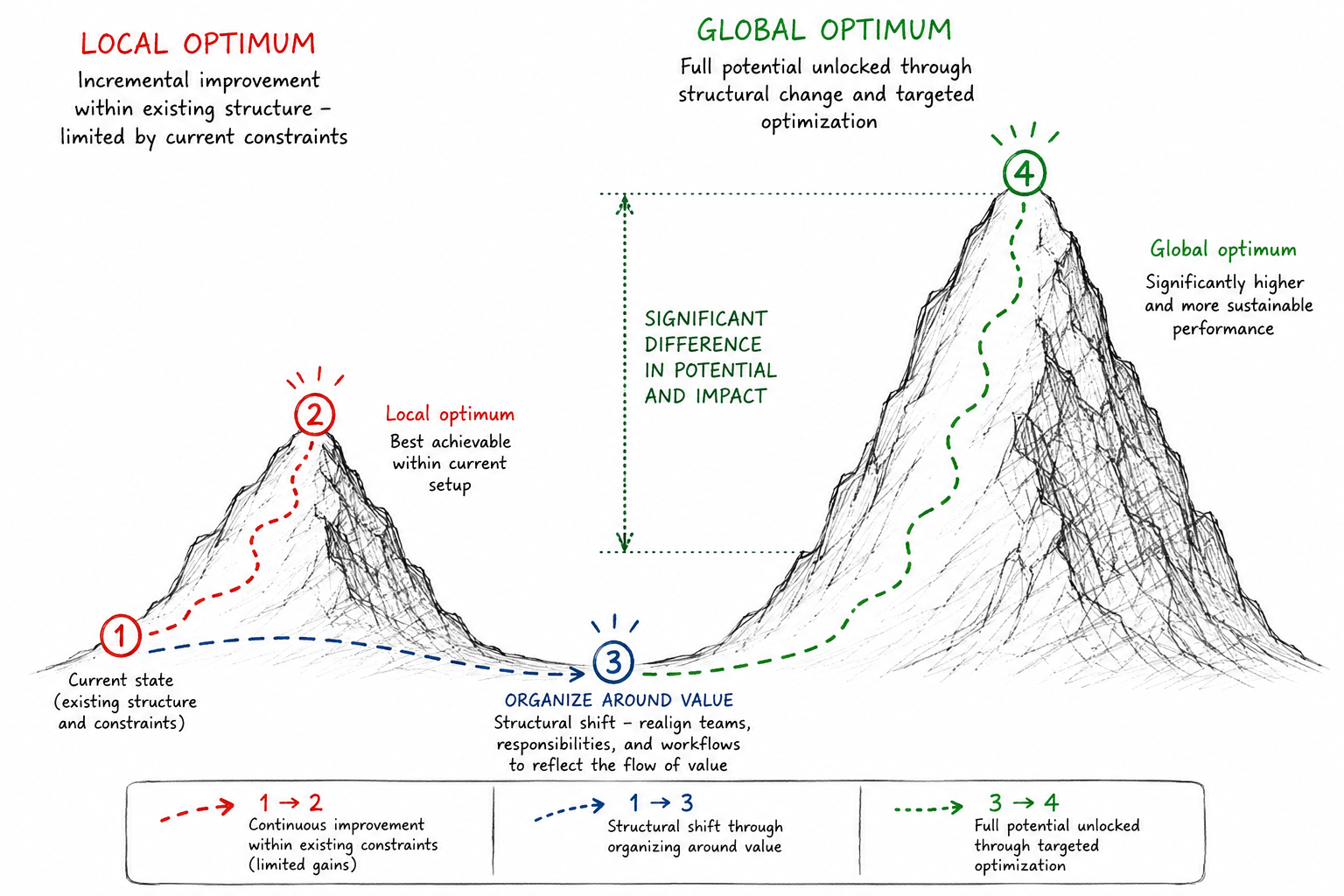
Continuous improvement focuses on making incremental gains within the boundaries of the existing system. These efforts, while valuable, are constrained by the current organizational structure and its inherent limitations.
Organizing around value, on the other hand, is a transformative step. It involves realigning teams, responsibilities, and workflows to reflect the actual flow of value. This structural change lays a far stronger foundation for meaningful, sustainable improvement.
By embedding this reorganization step into the identification phase, we do more than describe the value stream – we begin to actively shape it for better performance outcomes.
Let’s visualize this idea:
The local maximum (point 2, in red) represents the best performance achievable through continuous improvement within the current setup (point 1).
However, if we first organize around value, we move to a fundamentally better starting point (point 3). From there, we can pursue targeted optimization to reach a global maximum (point 4, in green), where value stream performance is significantly higher and more sustainable.
In short:
(3 → 4): Full potential unlocked through targeted optimization
(1 → 2): Limited gains within existing constraints
(1 → 3): Structural shift through organizing around value
Conclusions
Value Stream Identification makes the structure of value creation visible. The Value Stream Canvas bounds the system, the Assembly Line describes how it is put together, and the Issues & Findings List records how it behaves – with each finding anchored to the point in the structure where it occurs. What emerges is not a description of the work, but an explanation of the results: why lead times are what they are, why integration destabilizes where it does, why the same problems recur.
That explanation is what makes deliberate change possible. As long as structure stays invisible, improvement can only work on behavior – faster handovers, tighter coordination, more discipline – within an arrangement nobody chose and nobody can see. Those efforts are real, but they are bounded by the structure that produced the problem in the first place. This is why identification does not end with understanding: organizing around value changes what the system is capable of, not merely how well it performs within its current limits.
It is also what distinguishes this approach from traditional value stream methods. Because the model is built from the product rather than from the current process, current and target state are expressed in the same terms: what has to come together, where, to produce a releasable result. A better structure can therefore be modeled directly, rather than derived by removing steps from a map of how the work is done today – which is what keeps a target state anchored to the assumptions of the current one. The broader case for this modeling approach is developed in Why Value Stream Thinking?
References
- Meadows, D. H. (2008). Thinking in Systems: A Primer (D. Wright, Ed.). Chelsea Green Publishing, section Bounded Rationality (pp. 106-109). Meadows takes the term from Herbert Simon: people make quite reasonable decisions on the information they have, but that information is incomplete and delayed, particularly about more distant parts of the system. Simon’s conclusion is that we are not rational optimizers but satisficers, settling within a limited purview on a choice we can live with for now and changing only when forced to. Meadows draws the consequence explicitly: within the bounds of what a person in that part of the system can see and know, the behavior is reasonable, so taking one individual out of a position of bounded rationality and putting another in is not likely to make much difference. She is careful that this explains why the behavior arises rather than excusing it, and that change comes first from stepping outside the limited information available at any single place in the system and getting an overview. ↩︎
- See e.g. Chapter 8 in Pereira, Steve; Davis, Andrew. Flow Engineering: From Value Stream Mapping to Effective Action (English Edition) (S.129). IT Revolution Press. Kindle-Version. ↩︎
- Martin, J. (1995). The Great Transition: Using the Seven Disciplines of Enterprise Engineering to Align People, Technology, and Strategy. AMACOM.
James Martin came to a similar conclusion nearly 30 years ago. In Chapter 18, “TQM vs. Revolution,” he explores the pros and cons of continuous improvement versus fundamental redesign – emphasizing that, in some cases, breakthrough change must come first, before incremental improvements can be effective. We advocate a similar approach today: first organize around value, then begin optimizing the redesigned system. ↩︎
Author: Peter Vollmer – Last Updated on August 11, 2026 by Peter Vollmer