
Why Value Stream Thinking?
This article outlines the rationale behind Value Stream Thinking and how it connects modeling, organizational design, measurement, and deliberate improvement.
“Whenever there is a product for a customer, there is a value stream. The challenge lies in seeing it.”
– Mike Rother and John Shook, Learning to See 1
The Organizational Challenge
In many organizations, delivering value at the required speed and responding quickly to evolving market needs remains a systemic challenge. Legacy structures and siloed responsibilities create disjointed workflows that hinder alignment and collaboration. Project-based thinking overloads capacity, spreads individuals across too many initiatives, and slows down decision-making.
These challenges are even more acute in complex, software-intensive and cyber-physical environments such as automotive or aerospace. With large numbers of engineers and suppliers distributed across systems and sites, organizations lack a systematic way to visualize and optimize end-to-end value delivery. The result is inefficiency, slow responsiveness, and persistent misalignment between structure and value flow.
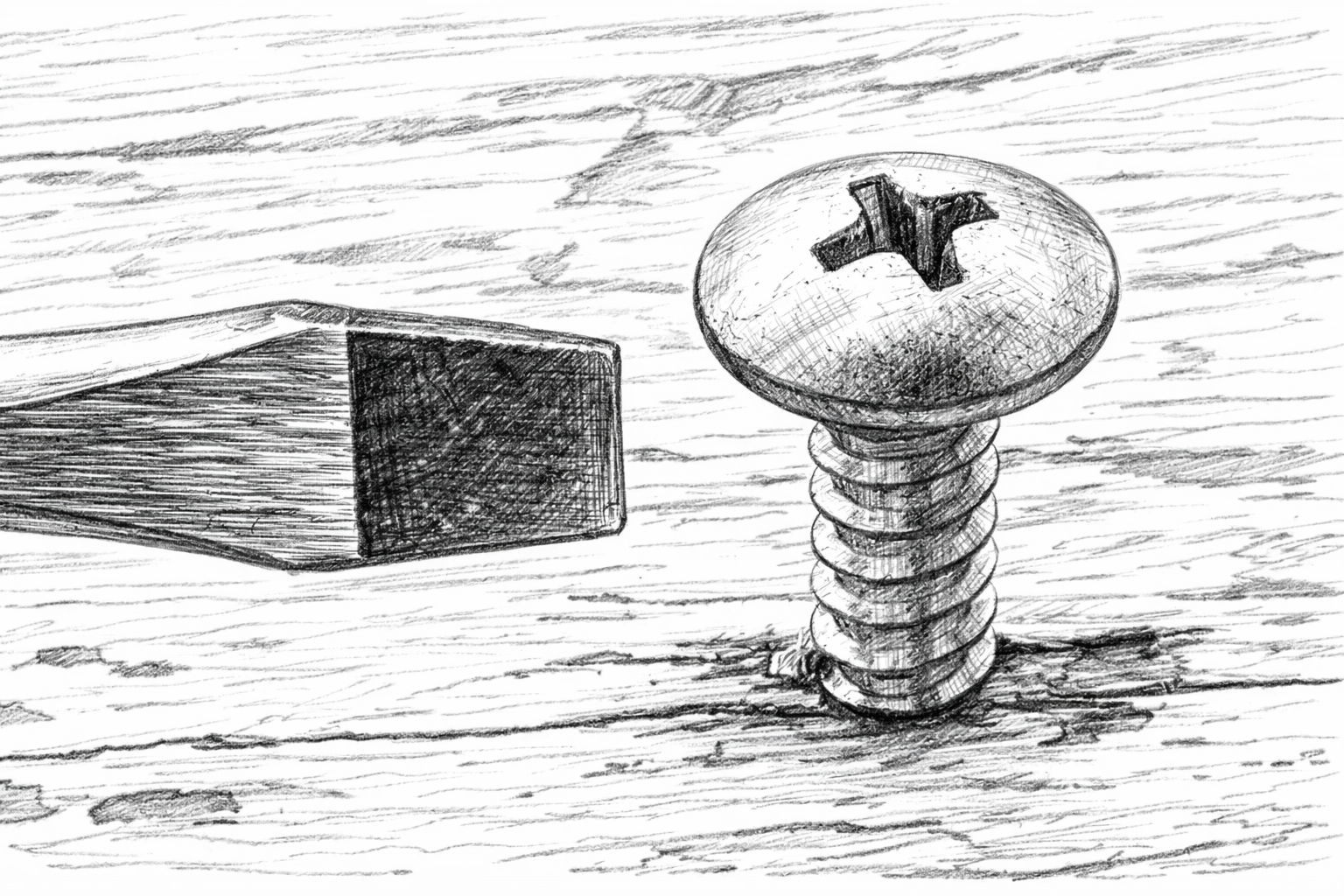
Traditional value stream methods, adapted from manufacturing, can be applied to product development – but often feel like using a flat-head screwdriver on a Phillips screw. You can make progress, but it takes more effort, is less precise, and the results are rarely optimal. Product development is not a linear, repeatable process; it is iterative, exploratory, and driven by learning cycles. Without the right tool and perspective, organizations struggle to see the real flow of value, spend more time than necessary on modeling and optimization, and miss timely, impactful improvements.
The Promise of Value Streams
The formal definitions and structural relationships underlying value streams are described in detail in the Concepts and Definitions article. Here, we focus on what becomes possible once they are visible.
As Rother and Shook emphasize, value streams are always present, even when they are not explicitly recognized. In many organizations, knowledge about the stream is fragmented: each team sees its part, but no one sees the whole. This invisibility leads to misaligned decisions, local optimization, duplicated effort, and systemic friction.
As Peter Senge describes in The Fifth Discipline2, teams operate based on shared mental models – internal representations of how things work. When these models are misaligned, so is action. Value Stream Thinking provides a shared lens across roles and departments, making the end-to-end flow of work visible – including the handoffs, delays, feedback loops, and integration points that often remain implicit.
Improving how an organization delivers value does not begin with new tools or more metrics. It begins with making the value creation system visible. A shared understanding of how value flows across the system enables better decisions, faster learning, and more coherent collaboration.
In short: you cannot improve what you do not understand.3 Understanding begins with seeing the system clearly – from individual value streams to the broader landscape of how they interconnect across the organization. That’s why the way we visualize value streams matters.
What Is Value Stream Thinking?
Value Stream Thinking (VST) makes the end-to-end flow of value visible, modelable, measurable, and continuously improvable – enabling people at every level to understand the system and steer it toward better flow and outcomes.
In practice this is not a single activity. Value Stream Thinking is applied Systems Thinking, with Assembly Line modeling at its core. It connects four recurring moves, held together by a shared intent: faster, high-quality value delivery and quicker response to change. They form a learning loop, but not a rigid sequence.
- Model to make the system visible. The model shows where work flows, where it waits, where it converges, and where feedback cycles close – and therefore where delays accumulate and defects escape.
- Design the structure to enable flow. Organizing around value reduces unnecessary coordination and hand-offs – because structure shapes behavior.4
- Measure to increase observability. Measurement quantifies what the model locates. And because it runs continuously, it shows how the system evolves rather than how it looked on the day it was modeled.
- Turn insight into change. Evidence is interpreted, insight emerges, and people decide how to intervene – by changing the value-creation system, refining the model or the measurement system, or combining these actions.
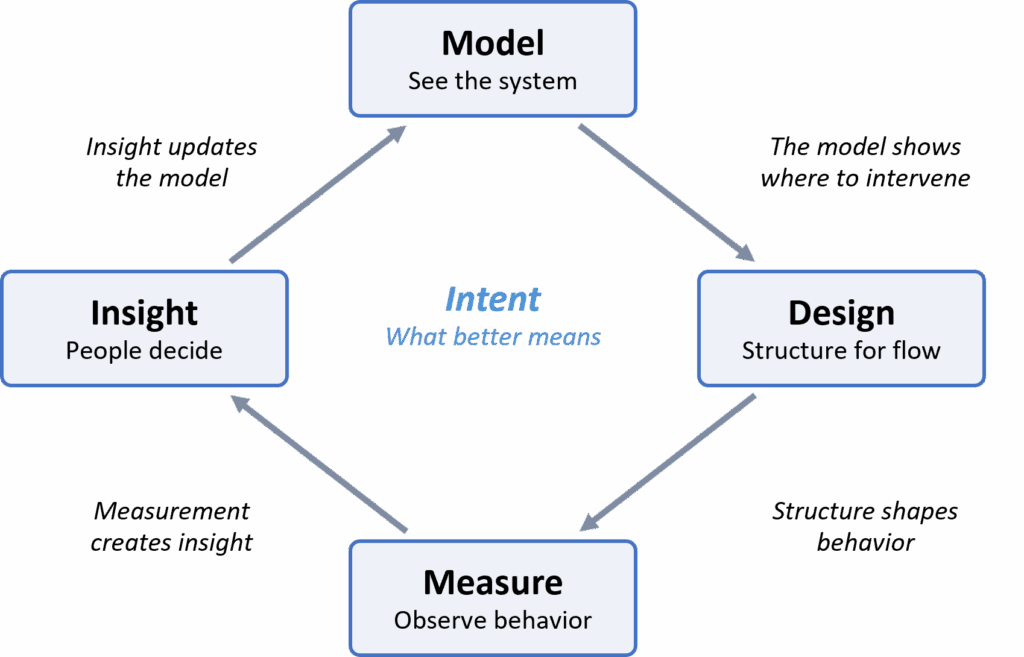
The four moves form a learning loop, not a rigid sequence. They relate to the three stages of the Value Stream Lifecycle – Identification, Organizing Around Value, and Systematic Improvement – but not one-to-one. The stages describe where the emphasis lies during a given period; the moves keep interacting across successive learning cycles.
The first turn uses a good-enough model and qualitative Issues & Findings to create a more flow-oriented and observable structure; subsequent turns progressively improve the model, the evidence, and the value-creation system, while the organization becomes better at seeing, understanding, and improving the system as a whole.
Value Stream Thinking does not replace lean principles, agile practices, DevOps concepts, Team Topologies, or leadership. Rather, it provides the system perspective within which these practices align and reinforce one another. Without understanding how value flows across teams, domains, and system boundaries, local improvements risk optimizing parts while the overall system remains constrained.
Modern organizations are not short of dashboards, metrics, or transformation initiatives. What they often lack is a suitable model that reveals how value actually flows – where it slows down, where it fragments, and how structural design decisions, policies and events influence performance. The way we represent a system determines what we are able to see – and what we are able to see determines how we can act and the decisions we make.
The Assembly Line Model serves this purpose. It is not a manufacturing metaphor, but a modeling approach suited to reveal integration points, feedback loops, dependencies, and performance dynamics in complex product development systems. These are the structural elements that generate a value stream’s behavior – and they cut across organizational boundaries rather than following them, which is why an organizational chart cannot show them.
The model resolves the system into Convergence Units – nested units of value creation, each spanning from a backlog to the convergence of the work that backlog produced, with clear responsibility for the validated result. Because the same pattern repeats at every level, the model allows organizations to zoom from enterprise landscapes down to individual sub-streams while maintaining a coherent view of the whole – creating a shared and consistent language for understanding and improving value delivery across the organization.
Seeing enables understanding. Understanding enables deliberate steering – and steering, applied repeatedly, is what compounds into sustained performance.
What Makes Value Stream Thinking Different
Traditional value stream mapping assumes flows that are stable, predictable, and repeatable. Product development is none of these, which is why the modeling approach – not just the diagram – has to be different.
Compared to traditional methods, Value Stream Thinking brings distinct advantages across all four moves:
Modeling
- Models the product, not the process – The Assembly Line is built right-to-left from the integrated product: what has to come together, at which integration stages, to produce a releasable result. Because it represents outcomes rather than current activities, the model stays compact where process descriptions become unmanageable – and current and target state can be expressed in the same language.
- Starts simple and grows with the improvement effort – Begins with the minimum modeling needed to establish a solid, well-designed structure, then adds precision as systematic improvement demands it. Each turn models what the next decision requires, so the model matures at the pace of the system it describes.
- Scales and zooms without losing coherence – From an individual sub-stream to enterprise-wide landscapes of interconnected systems, and back again, within one consistent representation.
Design
- Makes structure a deliberate decision – Integration boundaries, dependencies, and team interfaces become explicit, so organizational design can be reasoned about rather than inherited.
- Lets structure evolve with the system – Team constellations, collaboration modes, and integration boundaries can change as products, technologies, and demand evolve.
- Adapts to the organization’s pace and capacity – Scope, effort, and transformation batch size are matched to what the organization can absorb and act on, so change arrives in increments that can actually be implemented rather than in one large transformation program.
Measurement
- Measures the stream, not the people – Performance is observed at stream level, highlighting systemic constraints rather than individual output, and enabling leaders to create the conditions for success rather than assign blame.
- Connects local behavior to end-to-end performance – Stage-level measurement reveals where work accumulates and which part of the stream constrains overall delivery.
- Makes measurement diagnostic, not just indicative – End-to-end metrics can show that a value stream is underperforming even in a poorly designed structure. But when responsibilities, integration points, and measurement boundaries are fragmented, they cannot reveal where or why. Coherent boundaries make performance observable at multiple levels, so end-to-end signals can be traced to the parts of the system that produce them.
Insight and change
- Turns evidence into system-improvement decisions – Model and measurement together trace performance patterns back to the structure that produces them, so interventions target structural causes rather than symptoms.
With these characteristics, Value Stream Thinking does more than visualize value creation. It provides a coherent system view that bridges strategy, structure, and execution – enabling organizations to deliberately design and evolve how value flows.
Conclusion
Visibility is the precondition for deliberate system improvement. Once value flow is visible, the organization has a shared mental model – a common basis for seeing and discussing where performance suffers, what may be causing it, and how the system could be improved. It can then address a question it could not answer before: how should it be structured to enable the intended flow of value?
Answering it means aligning structures, responsibilities, and collaboration patterns with the way value actually moves through the system. Organizing around value and deliberately designing team interactions are the natural consequences of understanding the flow.
Structure, in turn, shapes behavior – and determines whether that behavior can be diagnosed rather than merely observed. Even in a poorly designed structure, end-to-end metrics may show that a value stream is underperforming. But when responsibilities, integration points, and measurement boundaries are fragmented, those metrics cannot reliably reveal where the problem originates or why it occurs.
Convergence Units create nested, coherent units of value creation with clear responsibilities and integration points. Because a similar pattern repeats at every level, performance becomes observable at each level, and end-to-end signals can be traced to the parts of the system that produce them. Measurement can then move beyond health monitoring and support diagnosis – providing the evidence needed for the next decision.
Value Stream Thinking connects these elements into an ongoing learning process in which clearer visibility enables more informed structural decisions, stronger observability, more precise diagnosis, and increasingly deliberate improvement across teams, domains, and enterprise landscapes.
Notes & References
- Rother, M., & Shook, J. (1999). Learning to see: Value-stream mapping to add value and eliminate muda (Version 1.3). Lean Enterprise Institute. ↩︎
- Senge, P. M. (1990). The Fifth Discipline: The Art and Practice of the Learning Organization. Doubleday/Currency. ↩︎
- This formulation is widely attributed to John Seddon, though I have not been able to trace an authoritative primary source. ↩︎
- Meadows, D. H. (2008). Thinking in Systems: A Primer (D. Wright, Ed.). Chelsea Green Publishing. Meadows argues that the structure of a system generates its patterns of behavior, and that understanding this relationship is what makes deliberate intervention possible: “Once we see the relationship between structure and behavior, we can begin to understand how systems work, what makes them produce poor results, and how to shift them into better behavior patterns” (Introduction). Structure in this sense is not the organizational chart. It includes integration points, dependencies, delays, information flows, policies, and feedback relationships – which is precisely what the Assembly Line makes visible, and why it cuts across organizational hierarchies rather than following them. ↩︎
Author: Peter Vollmer – Last Updated on August 12, 2026 by Peter Vollmer