
From AI Potential to Product Outcomes
An Analysis of Outcome Orientation, Value Streams, and Organizational Design
AI capabilities are advancing faster than operating models are adapting. Organizations often treat AI adoption and their operating model as separate topics with separate responsibilities – yet realizing AI’s potential depends on connecting the two. This article analyzes how Mik Kersten’s Output to Outcome and AI-Native SAFe address this connection in product development, and how Value Stream Thinking provides the insights needed to make the right decisions in organizational design and ways of working for your organization.
AI Changes the Conditions for Product Development
Technological revolutions change what is economically and technically possible. They also change the conditions under which organizations succeed. Carlota Perez describes this relationship as a shift in techno-economic paradigms: new technologies bring new principles for organizing work, collaboration, and value creation.
She makes an important distinction between a revolutionary technology and a technological revolution. In her interpretation, AI is a revolutionary technology embedded in the broader, ongoing digital revolution. Its potential therefore needs to be understood in the context of that wider transformation of information technology, the economy, and society.1 For organizations, this means that adopting AI tools is only part of the change: existing organizational structures, responsibilities, and ways of working can limit what the new technology enables. Realizing its potential therefore requires examining and adapting how the organization is designed and how its people work together.
But adaptation does not happen automatically. “Survival is not mandatory,” as the saying attributed to W. Edwards Deming puts it. Companies emerge, evolve, or disappear. Their future depends in part on how they interpret the changes and what they choose to do about them.
AI is a powerful driver of change within this larger transformation. Whatever the current hype, its impact must be assessed across the whole value creation system: as technology reduces some constraints, other bottlenecks become more significant. An AI strategy is therefore part of the broader business strategy and must be developed in alignment with organizational design, the funding model, and ways of working.
For product development, the challenge is to translate these strategic choices into a coherent operating model. How should investment, product direction, team responsibilities, architecture, and ways of working fit together as AI changes what people and teams can do? How do we ensure that faster execution leads to better customer and business outcomes?
Equally important is what this change does to us as people. How does working with AI influence our thinking, judgment, and capabilities? Which skills do we develop further, and which might we lose through delegation? How do we retain the ability to question goals independently and take responsibility for results?
Roberto Simanowski explores this risk through Hegel’s master–servant dialectic: in his application to AI, delegating the work can also mean losing the experience through which understanding and independence develop.2 Beth Smith makes a related argument using Dave Snowden’s 3S triad: salience, recognizing what matters in context; sapience, exercising judgment; and sentience, being affected by and having a felt stake in what happens. She argues that these capacities develop through engagement with real situations and consequences, and that outsourcing thinking can remove the conditions for their development.3 For product development, this raises a practical design question: which activities should AI take over, and where must people remain actively engaged so that they continue developing the judgment needed to direct and assess the work?
Preserving and developing these human capabilities is therefore a requirement for the operating model itself.
The Responses from Mik Kersten and Scaled Agile
Mik Kersten and Scaled Agile offer concrete models and guidance for evolving the operating model. Both place customer and business outcomes at the center, connecting strategic direction with how work is organized, funded, and continuously adapted through feedback.
Both build on earlier work: Kersten builds on the shift from project-based management to product-oriented value streams and the Flow Framework introduced in Project to Product4, while Scaled Agile evolves the Lean-Agile foundations and practices established through SAFe 6.
In Output to Outcome, Kersten builds on the established Product Operating Model with two central models. The Outcome Loop connects strategy and investment with outputs, measurable outcomes, and feedback. The Outcome Tree organizes value streams and their loops into a hierarchy with explicit leadership, funding, and outcome ownership.5
His seven shifts describe the organizational changes that support this model: Functions to Flow, Slop to Substance, Chaos to Cadence, Matrix to Modularity, Objectives to Ownership, Divisions to Domains, and Managers to Makers. Together, they call for modular value streams, meaningful measurement, clear accountability, a unified planning and feedback cadence, and leadership adapted to different development contexts and AI-enabled work.
Scaled Agile describes four shifts in established Lean-Agile practices: toward outcome-driven flow, AI-augmented cross-functional teams, faster learning and experimentation, and development and innovation at scale. A human-centric AI culture underpins these shifts, emphasizing AI fluency, human judgment, and trust in how efficiency gains will be used.6
AI-Native SAFe translates these shifts into guidance across several levels. Portfolio Outcomes and Investment Strategy connect desired outcomes with funding7. Product Vision and outcome-driven roadmaps give product development a shared direction.8 AI-Native ARTs and Teams organize collaboration9; PI Outcome Planning and Sense and Respond connect planning with regular learning and adaptation.10 The AI Value Architect helps connect AI capabilities, ways of working, and business value.11 Go-to-Market, ROI, and AI Governance and Ethics extend the perspective to adoption, economic viability, and responsible use.12
Kersten provides models, principles, and concrete organizational prescriptions, while leaving organizations to work out many of the detailed arrangements. AI-Native SAFe defines a more explicit framework of roles, events, responsibilities, and workflows. This provides a more detailed starting point, but still requires decisions about how it should work in a particular organization.
Value Stream Thinking: Making the Operating Model Work
Value streams are central to both Kersten’s and Scaled Agile’s approaches to evolving the operating model. Applying their guidance requires an understanding of how a particular organization actually develops products and creates value: how work flows, how contributions come together, how decisions are made, and how feedback leads to change.
Value Stream Thinking makes these relationships visible and provides a shared basis for examining and redesigning them. It starts with identifying and understanding existing value streams, then connects organizational design and ways of working with measurement, feedback, and systematic improvement. This helps organizations decide where AI can contribute, which changes are needed around it, and whether those changes achieve the intended effects.
Structure shapes behavior.
As Donella Meadows writes, “System structure is the source of system behavior.”13 That structure includes responsibilities, decision rights, incentives, information flows, and feedback loops. VST’s landscape perspectives and Assembly Line Model help examine these relationships, compare possible designs, and guide the transition from the current setup to a better one.
Identify the Value Streams and Design a Viable System
This is a familiar challenge from earlier waves of computerization. In The Great Transition (1995), James Martin described how companies used computers to automate existing processes while retaining organizational structures designed for an earlier era. His argument was that realizing technology’s potential could require redesigning both the processes and the organization, then continuously improving the new setup.
“Some changes, by their very nature, cannot be incremental. They need the introduction of a fundamental change – a break with the past.”14
AI brings this question back into focus: are we using new capabilities to accelerate existing activities, or also reconsidering how the work should be done and organized? New ways of working may allow activities to be combined and some steps or hand-offs to disappear altogether.
Example: Consider how an organization reports progress and makes decisions. AI could help teams write status reports faster and consolidate them for scheduled reviews. But this would preserve the existing process, including the wait between identifying a problem and acting on it. A redesigned approach could use AI and integrated tooling to make relevant information available in real time, identify issues that need attention, and request decisions from the responsible people as those issues arise. Separate reporting and consolidation steps could become unnecessary. The benefit would extend beyond time saved preparing reports: shorter feedback cycles, less manual effort, and earlier decisions. This is the opportunity to examine before optimizing the existing process.
VST therefore starts by identifying and understanding the value streams that already exist. Wherever an organization develops and delivers a product or service, work flows through a value stream, whether or not that flow is understood or deliberately designed. Tracing it across organizational boundaries reveals how contributions actually come together – and where interfaces, hand-offs, and decisions reflect departmental structures rather than the needs of value creation. The insights gained through identification provide the basis for a better design of the work and the organization supporting it.
The aim is to establish a setup worth improving. VST connects understanding the existing system with designing suitable value streams through Organizing Around Value, followed by systematic improvement. This may require changing team composition and boundaries, responsibilities, integration arrangements, or funding. This is what VST describes in global and local optimization.
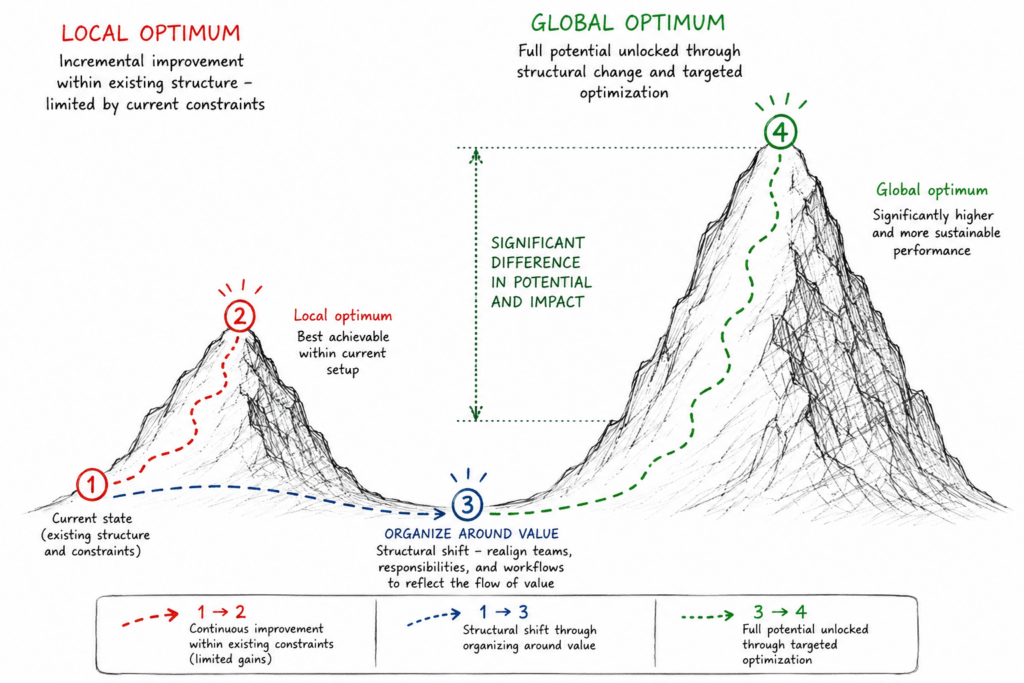
The Outcome Tree sharpens the focus on value creation by connecting value streams with the outcomes they are expected to achieve. Combined with an understanding of the actual work, this leads to three design questions:
- Are we developing the right products?
Do they address customer needs and contribute to the business outcomes we seek? - How should the contributing value streams be organized around the shared outcome?
Do their boundaries, responsibilities, and priorities enable their contributions to come together, and are local objectives aligned with the success of the whole? - Does work flow effectively within and between value streams?
Within each stream (intra-value-stream), we examine activities, queues, and feedback mechanisms. Between streams (inter-value-stream), we examine whether interfaces, hand-offs, and integration arrangements enable contributions to arrive when needed and in a usable form – and whether feedback from integration, downstream work, and product use reaches the contributing streams in time to inform their decisions and adaptations.
Complementary Views for Design and Steering
The three questions require complementary perspectives: on product direction, on the organization of contributing value streams, and on how work and feedback flow through the development system.
1. Are we developing the right products?
Product Vision, Roadmaps, and OKRs connect strategic direction with planned initiatives and measurable outcomes.15 The product vision describes the future we seek to create. Roadmaps outline how we intend to pursue that direction, while OKRs define what we aim to achieve and how we will assess progress.
Market analysis, customer insight, and business strategy inform that direction. Each initiative is based on a hypothesis about how it will create customer value and contribute to business success.
Experiments and feedback test these hypotheses. The quality of the hypotheses, the relevance of the experiments, and the speed with which evidence informs decisions all influence the likelihood of success. They cannot guarantee it. Over time, the evidence may also justify revisiting the broader direction.
2. How should the contributing value streams be organized around the shared outcome?
Kersten’s Outcome Tree is a simple and appealing representation of an organization.16 It connects strategic outcomes, value streams, funding, and ownership in a form that leaders and teams can readily discuss. For relatively simple products and organizations with few dependencies, it may provide sufficient structural orientation.
In organizations developing multiple products and variants, architectural choices, coexisting technology generations, and shared platforms and services create dependencies that cross the tree’s branches. Domains often need to advance new technologies while continuing to support earlier generations across several products. A domain model helps make these responsibilities and dependencies explicit, providing a basis for organizing the contributing value streams and coordinating their development and integration work.17
From a VST perspective, the Outcome Tree primarily provides an Enterprise-Level Landscape View. The Domain Landscape adds detail about the contributing value streams, their boundaries, and their development and integration relationships. Together, these views support decisions about responsibilities, interfaces, and coordination around shared outcomes.
3. Does work flow effectively within and between value streams?
A structural representation alone cannot show whether the development system works well in practice. The Domain Landscape shows how contributing value streams are organized within a domain. Assembly Line modeling connects these contributions across development and integration contexts, while the Performance & Observability Landscape adds evidence of how work and feedback actually flow within and between them.
These perspectives help distinguish problems within a value stream from problems caused by interactions between streams. They also help assess whether a local improvement benefits the overall value creation system.
From the current organization to the intended design
Where funding follows projects and responsibilities are divided across functional silos, the Outcome Tree’s alignment of funding and ownership with value streams describes a target state. The Transformation Landscape helps examine how the existing organization can evolve toward that design, making structural dependencies and possible intermediate arrangements visible.
As Shane Parrish and Rhiannon Beaubien write in The Great Mental Models:
“The more lenses used on a given problem, the more reality reveals itself.”18
VST applies this idea to organizational design through four complementary landscape perspectives:

These are complementary views of the same development system. Each supports a different set of design and steering decisions, summarized below. See the four VST landscape perspectives for a detailed explanation.
| VST perspective | Decisions it supports |
|---|---|
| Enterprise-Level Landscape | Identify value streams and connect value creation with ownership, funding, and governance. Compare existing arrangements with the Outcome Tree’s target model. |
| Domain Value Stream Landscape | Design the internal structure of a domain, including sub-streams, shared components, reuse, and the boundaries needed for flow and autonomy. |
| Performance & Observability Landscape | Locate measurements and feedback so that waiting times, quality problems, rework, and constraints can inform improvement decisions. |
| Transformation Landscape | Compare current, intermediate, and target arrangements, making dependencies and the coexistence of old and new structures explicit to inform the transformation roadmap. |
The Assembly Line Model helps translate these perspectives into concrete decisions about integration and collaboration.
Make Integration and Collaboration Explicit
The second and third design questions meet at integration: how should contributing value streams be organized, and how can work flow effectively within and between them? Assigning ownership of an outcome is only part of the answer. We also need to determine which contributions must come together, where they are integrated and validated, and how feedback reaches those who need to act on it.
The Assembly Line Model makes these relationships explicit. It connects the product’s structure with the development work required to produce a functioning whole. This helps us decide where interfaces, team boundaries, and integration responsibilities should lie.
These integration requirements provide the basis for defining Convergence Units and the teams needed to support them.
Design How Contributions Come Together
The Assembly Line Model provides a basis for defining Convergence Units: units of value creation in which specified contributions are brought together and validated to produce a usable result. Their design starts with the work: what needs to come together, which activities are required, and what criteria determine whether the result is ready for use or further integration? Depending on the scope and cognitive load involved, a Convergence Unit may be supported by one team or a stable system of teams. Smaller units can contribute to larger integration contexts.
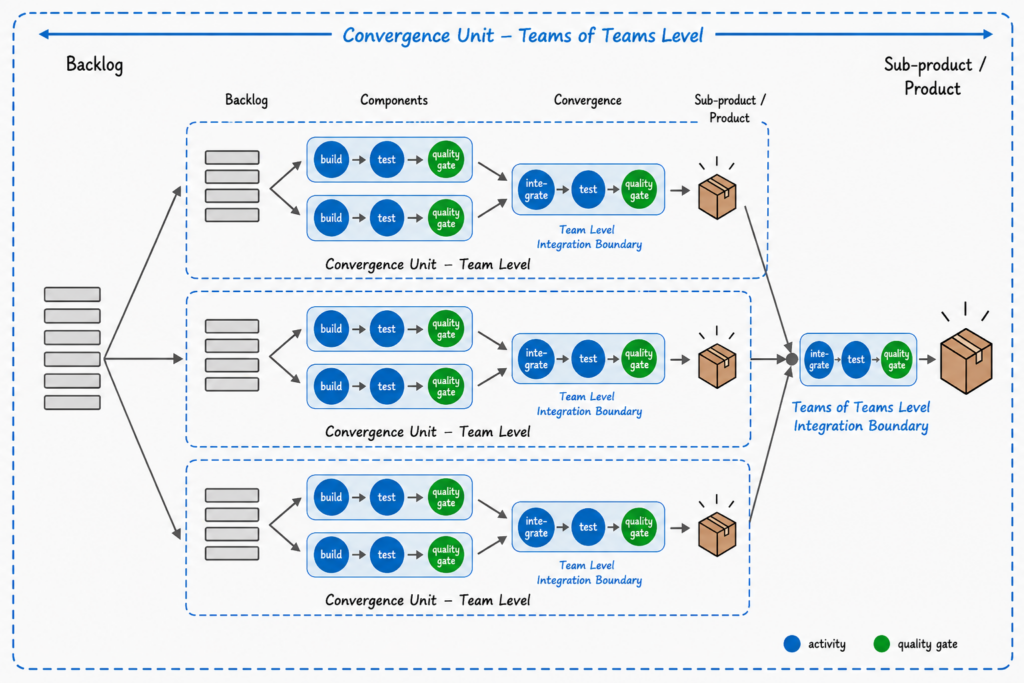
Automotive development illustrates why these boundaries need careful design. A shared component may contribute to several vehicle systems, models, and variants developed in parallel. It can have one clear owner while its changes must be integrated and validated in several contexts, each with different requirements and schedules. Convergence Units can therefore overlap in the components and contributions they require. Making these relationships explicit helps distinguish responsibility for the shared component from responsibility for its integration into each product. It also exposes the need to resolve competing requirements, priorities, and capacity demands.19
Kersten’s Outcome Tree establishes outcome ownership and strategic alignment. AI-Native SAFe provides roles and practices for organizing collaboration within and across ARTs. VST helps work out how these arrangements should fit the development system: where contributions need to converge, who is responsible for the integrated result, and how interfaces and feedback connect the participating value streams. An AI-Native ART can provide an organizational implementation of a Convergence Unit spanning multiple teams.
A node in the Outcome Tree, an ART, and a Convergence Unit should therefore not automatically be treated as equivalent. Their relationship needs to be established from the products, architecture, dependencies, and capabilities involved. The central design question is:
Does responsibility for an outcome come with the authority, capabilities, and collaboration needed to bring the required contributions together?
Connect Measurement, Feedback, and Cadence to the Value Stream
Defining value streams, Convergence Units, and responsibilities gives us a proposed design. We then need evidence of whether that design works: do contributions come together reliably, does work flow effectively, and does the resulting product create customer and business value?
Kersten’s Outcome Loop connects work with its intended outcomes and the feedback needed to adapt. VST helps locate measurements and feedback paths in the actual development system. Three complementary types of evidence support different decisions:
| Question | Evidence | Decisions it informs |
|---|---|---|
| Does the solution work? | Integration results, tests, and validation of components working together. | Change the solution, its interfaces, or how it is integrated and validated. |
| Does the development system work? | Lead times, queues, hand-offs, rework, and constraints on flow. | Change work practices, capacity allocation, or organizational boundaries. |
| Are we achieving customer and business outcomes? | Customer task success, adoption, purchasing decisions, renewals, and costs. | Continue, adapt, or stop a product initiative; reconsider the underlying assumptions. |
These observations need to be interpreted together. A feature may work correctly and reach customers quickly without helping them accomplish their task. Even a useful feature does not automatically generate revenue or reduce costs. The connection between outputs, customer benefits, and business results remains a hypothesis to test.
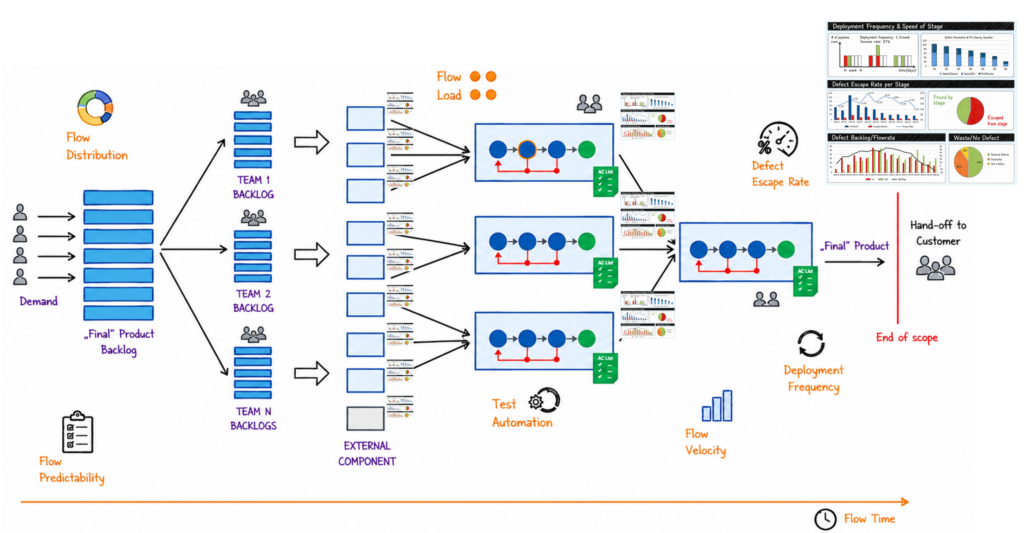
The Assembly Line Model helps identify where evidence becomes available and where it is needed. Integration failures must reach the contributing teams; downstream delays may require changes in upstream work; customer feedback may call for a decision across several value streams. Designing these feedback paths means clarifying who receives the information, who can act on it, and how quickly a response is needed.
The illustration below shows technical and flow measurements within development, ending at the hand-off to the customer. Assessing outcomes requires extending observation beyond that boundary to product use and business results.
Turn Learning into Decisions
Both Kersten and SAFe emphasize cadence. Kersten calls for unified planning and feedback cycles across the Outcome Tree; SAFe makes regular alignment and adaptation concrete through PI Outcome Planning and Sense and Respond.20
VST connects these practices to the development and integration structure: when do contributions need to come together, when does reliable evidence become available, and who needs to decide on a response? Shared cadence supports alignment and collective learning. Decisions that can be made locally should not wait for the next scheduled event.
Example: If AI enables one team to produce changes faster than other streams can integrate them, local productivity may increase while unfinished work accumulates. Technical and flow evidence can reveal the mismatch. The response may involve changing priorities, limiting work in progress, adjusting interfaces, or reallocating capacity. A shared value stream model helps assess which response improves the overall system.
More experiments and faster feedback only help when the resulting learning informs decisions – including decisions to adapt, expand, or stop work based on its contribution to the intended outcomes.
Plan the Transition and Test Its Effects
The organization cannot usually move from its current setup to a new operating model in one step. Funding cycles, shared platforms, existing responsibilities, and products already in development constrain the sequence.
The Domain Landscape shows how a domain currently organizes development across products, variants, and technology generations. The Transformation Landscape builds on this understanding to examine how that organization could evolve: where product responsibility is already coherent, where project-based structures fragment development, and how one or more value streams could better support the domain’s products. It makes possible target designs and intermediate arrangements explicit. A transformation roadmap then sets out the steps and sequence for putting the chosen design into practice.
AI-Native SAFe provides an Implementation Roadmap21. VST complements such guidance with a model of the particular organization: its starting point, intended structure, and dependencies that must inform the transition. A proposed redesign remains a hypothesis whose effects need to be observed.
Consider an ADAS domain developing capabilities for several vehicle lines. Each vehicle program funds its own development projects. As a result, separate teams implement similar capabilities in parallel, sometimes within the same technology generation, while earlier generations also require continued development and support. The Domain Landscape makes these parallel streams, shared components, and generation-specific requirements visible.
A possible target design gives stable product teams responsibility for shared ADAS components. Vehicle programs obtain suitable variants from these product value streams instead of commissioning separate implementations. This need not mean a single value stream for the whole domain: different products or technology generations may require distinct streams, with explicit interfaces and integration responsibilities.
The transition must accommodate vehicle programs already underway. An initial step could therefore focus on one component for the next technology generation. Two vehicle lines jointly fund its development, and a stable team takes responsibility for developing and maintaining it. Integration and validation responsibilities remain explicit for each vehicle context. Earlier generations initially continue within their existing arrangements.
The Transformation Landscape makes the coexistence of shared product value streams and remaining project-based structures explicit, so their dependencies can inform the next transition steps.
Evidence then informs the decision to adjust or extend the design. Does duplicated development decline? Do changes reach both vehicle lines reliably? Do integration effort and waiting times decrease, or does the shared team become a new bottleneck? The same assessment should consider how the changes affect people’s ability to learn and exercise judgment. The transition becomes a sequence of deliberate organizational changes, informed by their effects on the whole value creation system.
Turning AI Potential into Product Outcomes
AI can accelerate execution, but better customer and business outcomes depend on how the whole development system works. Kersten’s Output to Outcome and AI-Native SAFe address this challenge through outcome-oriented operating models, with value streams at their center. Applying their guidance requires concrete choices about products, architecture, funding, responsibilities, and ways of working.
Value Stream Thinking provides a shared basis for making those choices. Its landscape perspectives connect strategic alignment with domain design, observed performance, and organizational evolution. Assembly Line modeling makes explicit how contributions must come together and how feedback should inform decisions. Together, these models help determine whether outcome ownership is supported by the structures and capabilities needed to deliver.
The resulting design must then prove itself in practice. Product initiatives remain hypotheses about customer and business value; organizational changes remain hypotheses about how to enable that value more effectively. Measurement, feedback, and deliberate intermediate steps allow both to be assessed and adapted, while keeping human learning and judgment part of the design.
Realizing AI’s potential therefore requires more than faster activities. It requires understanding and shaping the system through which those activities contribute to useful products and sustainable business success.
Notes & References
- Perez, Carlota (2002). Technological Revolutions and Financial Capital: The Dynamics of Bubbles and Golden Ages. Cheltenham, UK / Northampton, MA, USA: Edward Elgar Publishing.
See also Perez’s 2025 talk, Historical Lessons for Embracing AI Effectively: Translating Technology into Business and Economic Value. Perez distinguishes a revolutionary technology from a technological revolution: the former is a major breakthrough within a broader paradigm; the latter comprises interdependent technologies and infrastructures that transform the economy and its organizational and institutional arrangements. In this interpretation, AI is a revolutionary technology within the ongoing digital – or information and telecommunications – revolution, rather than a separate technological revolution. Her argument goes beyond classification: achieving desirable social and economic outcomes from AI requires shaping the direction of the information revolution as a whole, of which AI is an inseparable part. At the organizational level, we draw a corresponding implication: AI strategy should be connected to the broader development of products, information technology, and the structures through which value is created. This organizational application is our interpretation of her broader argument. See also Perez’s research overview. ↩︎ - Simanowski, Roberto (2025). Sprachmaschinen: Eine Philosophie der künstlichen Intelligenz. Munich: C.H.Beck, especially “Die Herrin und ihr Knecht.” See also his discussion of Hegel and AI. The reference is to Simanowski’s application of Hegel’s account of lordship and bondage in Phenomenology of Spirit (1807), not to a claim by Hegel about AI. ↩︎
- Smith, Beth (2026). “First the Man Shapes the Tool, Then the Tool Shapes the Man.” The Cynefin Co, September 18. Smith draws on Dave Snowden’s triad of salience, sapience, and sentience to examine how cognitive outsourcing can affect the development of human judgment. The connection to product development and organizational design made here is our application of that argument. ↩︎
- Kersten, Mik (2018). Project to Product: How to Survive and Thrive in the Age of Digital Disruption with the Flow Framework. IT Revolution Press. ↩︎
- Kersten, Mik (2026). Output to Outcome: An Operating Model for the Age of AI. IT Revolution. ↩︎
- Scaled Agile, Inc. (2026). “The Four Critical Lean-Agile Shifts in the Age of AI.” Scaled Agile Framework. ↩︎
- Scaled Agile, Inc. “Portfolio Outcomes and Investment Strategy.” Scaled Agile Framework. ↩︎
- Scaled Agile, Inc. “Product Vision and Roadmap” and “ART Outcomes.” Scaled Agile Framework. ↩︎
- Scaled Agile, Inc. “AI-Native ART” and “AI-Native Teams.” Scaled Agile Framework. ↩︎
- Scaled Agile, Inc. “PI Outcome Planning” and “Sense and Respond.” Scaled Agile Framework. ↩︎
- Scaled Agile, Inc. “AI Value Architect.” Scaled Agile Framework. ↩︎
- Scaled Agile, Inc. “Go-to-Market”, “Return on Investment”, and “AI Governance and Ethics.” Scaled Agile Framework. ↩︎
- Meadows, Donella H. (2009). Thinking in Systems: A Primer. Edited by Diana Wright. Earthscan, p. 89, Chapter 4, “Why Systems Surprise Us,” subsection “Beguiling Events.” ↩︎
- James Martin, The Great Transition (1995), p. 251. ↩︎
- Product visions, roadmaps, OKRs, and feedback cycles predate the current wave of AI. Outcome measurement was also part of established SAFe guidance. Kersten and AI-Native SAFe place renewed emphasis on connecting these practices with funding, ownership, and recurring decisions across value streams. AI can accelerate execution and experimentation, increasing the need to coordinate learning and stop work that does not advance outcomes. AI-Native SAFe also addresses additional concerns such as model performance, shared evaluations, and AI governance. ↩︎
- I congratulate Mik on introducing a model that communicates an important organizational idea with such clarity and simplicity – qualities that VST’s more detailed representations sometimes lack. That simplicity is valuable for building shared understanding and direction. Carrying a transformation through, however, often requires additional perspectives and more detailed models to work through the dependencies, integration needs, and transition steps of a particular organization. The challenge for VST is to preserve that clarity while providing the detail needed for informed design decisions. ↩︎
- “Domain” has different meanings here. In Output to Outcome, Chapter 9 (“Sixth Shift: Divisions to Domains”), Kersten draws on Geoffrey Moore’s Zone to Win to distinguish four Outcome Domains – Core, Platform, Incubation, and Transformation – according to business contribution and position in the innovation life cycle. This supports differentiated funding, management, and measurement; innovation is not confined to the Incubation and Transformation Domains. In VST’s automotive example, a domain such as ADAS or Infotainment delivers related sub-products across multiple vehicle lines, variants, and technology generations. These are complementary dimensions: Kersten’s classification helps distinguish management needs, while VST’s Domain Landscape makes the internal value streams, architectural dependencies, reuse, and integration relationships explicit. Organizing by Outcome Domain alone does not resolve these structural design questions. See also Value Stream Landscapes in Automotive. ↩︎
- Shane Parrish and Rhiannon Beaubien, The Great Mental Models, Volume 1: General Thinking Concepts, 2024 edition, Introduction ↩︎
- These design considerations are explored in greater detail using the Mercedes example in this webinar recording. ↩︎
- Scaled Agile, Inc. “PI Outcome Planning” and “Sense and Respond.” Scaled Agile Framework. ↩︎
- Scaled Agile, Inc. AI-Native SAFe Implementation Roadmap ↩︎
Author: Peter Vollmer – Last Updated on October 7, 2026 by Peter Vollmer